

GenAI Wins Budget, But CMOs Still Don’t Trust It Alone
A new global study from SAS and Coleman Parkes finds GenAI has shifted from pilot to plumbing, with 85 percent of marketers now using it, 15 percent fully embedding it into daily workflows and 93 percent holding dedicated GenAI budgets for 2025 and 2026.
Eight in ten marketers report a return on GenAI investment, rising to 98 percent among “agentic AI adopters,” with the biggest gains in personalization at 94 percent, large data set processing at 91 percent and operational time and cost savings at 90 percent.
The same report shows a new divide opening up around autonomous, agentic AI, where only 21 percent of marketers are actively testing live deployments even though 51 percent plan to invest in the technology in the next year. Marketers are sorted into three maturity groups, observers, planners and adopters, and adopters are about one and a half times more likely than observers to see GenAI ROI and far more likely to use AI for audience targeting, journey design and real-time decisioning.
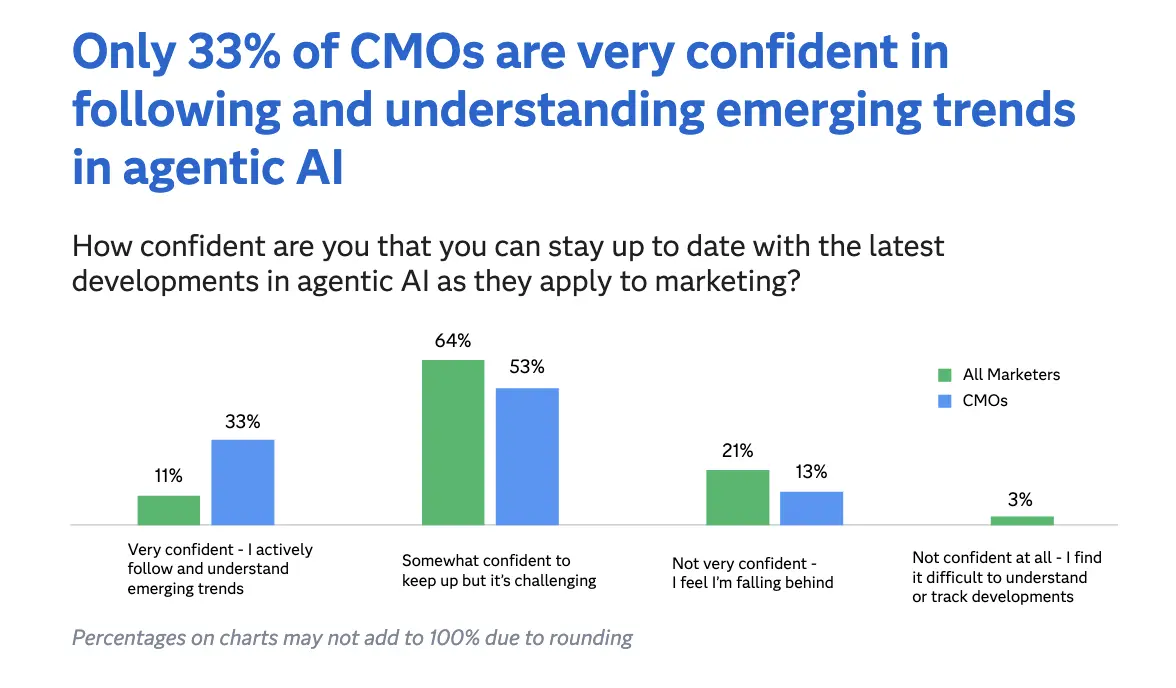
Despite the momentum, trust remains strictly conditional, with 90 percent saying they only trust agentic AI with human oversight and nearly half wanting humans to review and approve every AI generated marketing decision.
Governance is a weak spot, as only 8 percent of marketers describe their GenAI governance as well established and comprehensive, while 73 percent of observers admit they have no agentic AI governance in place at all. As AI maturity increases, horizons widen, with 31 percent of agentic adopters expecting quantum computing to have marketing applications within two years and half already incorporating quantum into their digital or innovation road maps.
For banks, insurers and fintechs facing regulatory scrutiny, the study lands as a clear signal that CMOs must both scale the GenAI use cases that already pay off and build the human in the loop and governance structures needed before agentic and quantum-driven marketing are allowed to run at full speed.
Download the full report: SAS