
Davos 2026: Financial Marcomms Survival Guide
The World Economic Forum kicks off each January in the Swiss Alpine town of Davos, and if you're heading there for the first time, congratulations. You're about to experience one of the most intense networking weeks of your career. If you're a veteran, you already know: Davos is equal parts exhilarating opportunity and logistical gauntlet.
This year's theme, "A Spirit of Dialogue," promises meaningful conversations, but for many attendees, the real value comes from impromptu hallway meetings, overheard insights at coffee stations, and connections you make while waiting in security lines. Think of it as speed dating for your career, except everyone's wearing snow boots with their business suits.
The basics: Getting there, staying sane
Plan your accommodations early. Joseph Raczynski, technology consultant and Davos regular, puts it bluntly: rooms in Davos proper can run $35,000 for a single with a bathroom. If the GPS says your accommodation is 7 miles away, budget 45 minutes for slippery mountain roads and security checkpoints. Always keep your passport handy.
Dress like you mean business (from the ankles up). Jennifer Cain Birkmose, global health advocate and WEF speaker, nails the dress code advice: think of it like a mullet haircut. Business from the ankles up, sporty and snow-capable from the ankles down. "In a sea of black clothing, please wear some color," she advises. You'll see heads of state in heavy-duty snow boots with their suits.
Budget time and pack smart. If GPS says a walk is 10 minutes, give yourself 20 for security checkpoints and crowds. Jezz Farr, senior communications adviser to major international banks, describes the chaos: "Such is the throng of people it is often difficult to find a quiet corner for a chat."
Toss protein bars into your bag and bring water. Cold weather drains phone batteries incredibly fast, so carry a portable charger.
The "Davos Cough" is also real, so bring hand sanitizer.
Networking: The real event
Keep flexible for happy accidents. Birkmose recommends scheduling core meetings but holding plenty of time for impromptu encounters. If you keep an open and curious mindset, less "what can I get" and more "what can I learn," you'll have a more rewarding experience.
Meet speakers before the panel starts, not after. If you're looking to meet a speaker, catch them before the event starts as they're getting mic'd up. After the talk, there's a surge of people rushing to talk to them.
Digital and physical cards. Use LinkedIn or WhatsApp QR codes to transmit your data. Take a selfie with your new connection and send it to them. But also carry physical business cards. Have both ready.
Open the door and go in. Along the Promenade, hundreds of companies have rented every storefront. Raczynski encourages boldness: "Don't be shy. Some are drop-in rooms with coffee. Just ask at the reception desk. Open the door and go in!"
Evenings are where magic happens. Farr describes the shift at 6pm: "The bars and restaurants begin to fill up, sponsored events kick off and people start letting their hair down." Plan carefully and get there early.
Ground yourself daily. The pace is fast and frenetic. Don't skip your daily practice during WEF week, whether that's your run, yoga, meditation, or journaling. It keeps you centered and focused.
The hot topic: AI gets down to business
The conversation around AI has shifted dramatically. Tori Cowley, reputation consultant and top 100 global communicator, notes that Day 3 of Davos 2026 was "one of the liveliest and most energised WEF meets" she's attended. Key conversations: how to manage reputation in an AI age, and a renewed focus on business performance over positioning.
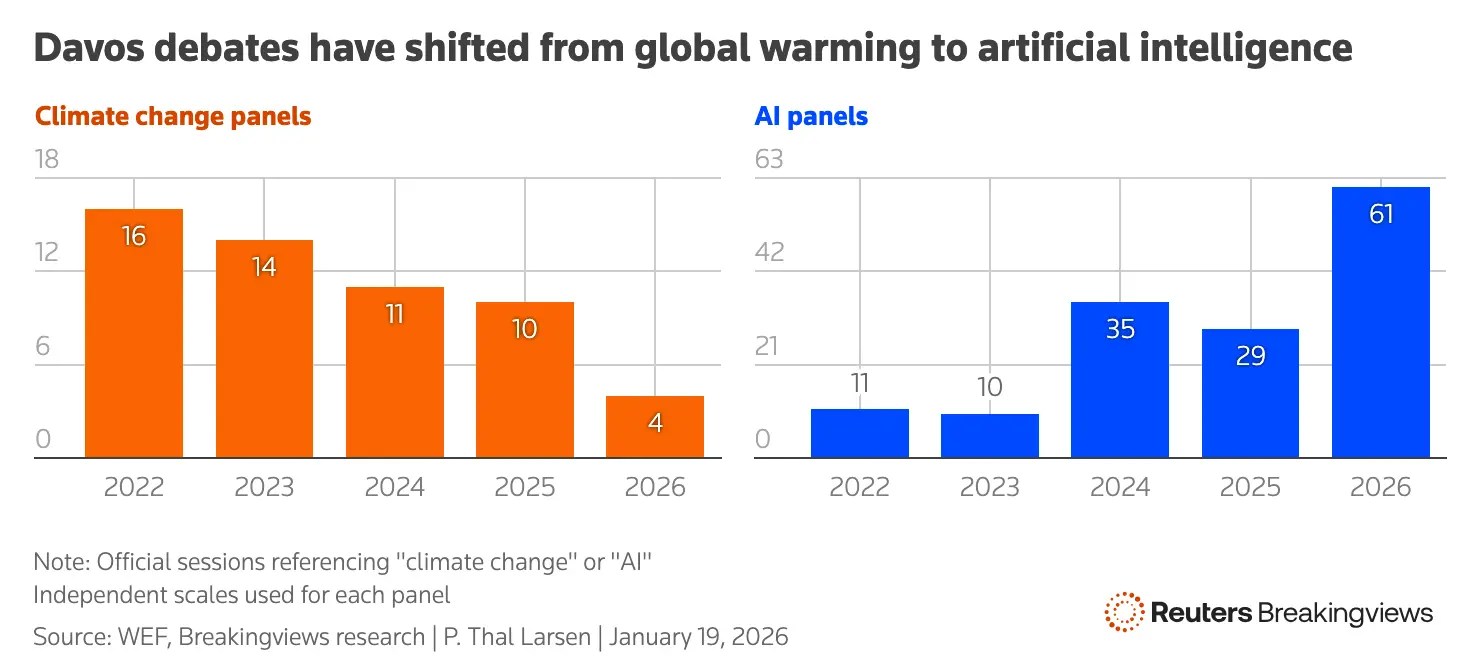
Reuters' Peter Thal Larsen observes that this year's WEF has embraced discussions of technology, deals, and realpolitik. The organization's risk-perceptions survey now lists economic confrontation, misinformation, and societal polarisation as the most pressing problems, a change from previous years when environmental issues topped the list.
Sam Burns, Global CMO of KPMG, participated in Brand Finance's "AI Rising: The Evolution of Brand and Trust" breakfast session. KPMG was one of the first organizations to launch a Trusted AI Framework. The firm's "You Can with AI" campaign has been instrumental in positioning KPMG as a leading advisor in the AI space.
Dr. Leeya Hendricks, founder of Hark Consultants and author of the forthcoming The Platform Playbook, has been deliberately talking platforms at Davos. One line from the AI House session stayed with her: "AI can't lead change, that's your job." Trust drives adoption.
Brenda Tsai, Chief Marketing Officer at Bloomberg, moderated a closed-door CMO roundtable at Bloomberg House where marketing leaders explored what she calls "the new frontier of brand experiences in the intelligence era." Her key takeaway: brands are shifting from megaphones to orchestrators, and the customer journey is no longer linear but conversational and generative. "The future of brand leadership sits at the intersection of intelligence, creativity, and trust," she noted, emphasizing that transparency and consent aren't constraints but strategic advantages.
Carpe Davos
Birkmose's advice captures the Davos spirit: "This is not a moment to be 'demure' and wait for things to happen. Make it happen: be in the moment, be focused, be present, listen, absorb and if you want to make a connection, seize the moment and be the creator of connections, ideas and inspirations. It's all up to you."
Farr sums up the Davos experience perfectly: trudging through freezing snow at 2am, thinking two things. First, what a fantastic and productive day with many positive meetings. Second, and more urgently, hoping you still have some painkillers left in your bag.
Welcome to Davos.