
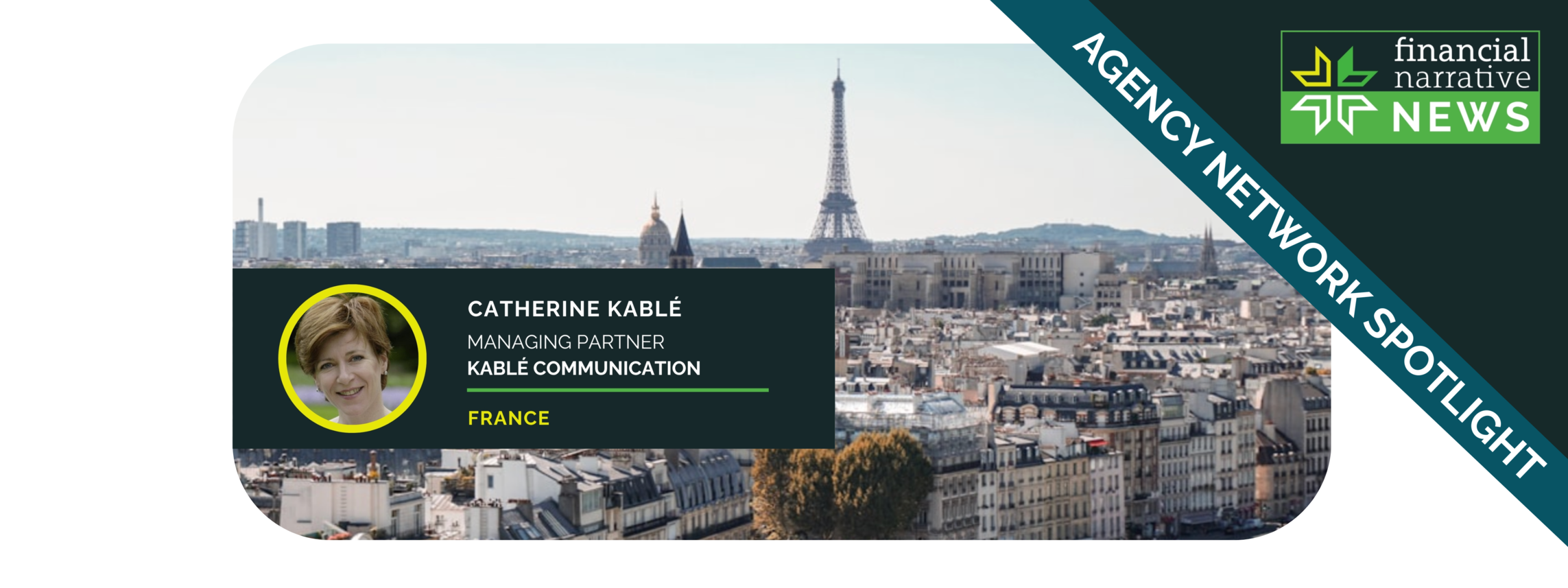
Financial Communications in France: Credibility, Localisation and the Long Game
In this Agency Network Spotlight, we turn to Catherine Kablé, Founder and CEO of Kablé Communication, for an expert perspective on what it takes to earn trust and build a reputation in one of Europe's most sophisticated financial markets.
Based in Paris and advising financial institutions for more than 30 years, Catherine brings a corporate banker's rigour and a communicator's instinct to the challenge of financial PR in France — a market where credibility must be established before visibility is sought, where education outperforms promotion, and where the playbooks that work in London or New York rarely translate without adjustment.

France's financial communications landscape: why education and consistency beat noise
France remains a relatively conservative market when it comes to financial services. For many French people — and even for many journalists outside the specialist financial press — finance is not a topic of natural interest. It can also be associated with mistrust. This makes communication both challenging and highly strategic: financial brands must first build credibility, clarity and trust before seeking visibility.
In this context, "wow effect" communication is often counterproductive. Trust takes time to build, especially in areas such as banking, investment, savings, payments or wealth management. Successful financial communications in France tend to be educational, evidence-based and consistent over time.
Several key trends are shaping the market:
-
A growing need to make finance more accessible, without oversimplifying complex issues.
-
Increased scrutiny around transparency, fees, risk, performance and governance.
-
Stronger demand for expert commentary on regulation, markets, ESG, private assets and the real economy.
-
The rise of AI as a major communication topic, covering both opportunities and risks: use cases, governance, productivity, impact on jobs, transformation of financial professions, data protection and client trust.
-
For B2C and B2B fintechs, including neobanks, the need to combine three imperatives: a seamless user experience, robust infrastructure, and a clear commitment to transparency and trust.
In terms of communications and marketing strategies, the most effective approaches are those that help financial brands become useful, credible and visible over time. Thought leadership, expert commentary, educational content, data-led insights, market studies and strong media relationships remain particularly effective in France.
For financial brands, success is less about creating noise than about building authority. The brands that perform best are those able to explain what they do clearly, demonstrate their relevance to the French market, and show how they help clients navigate a more complex financial, technological and regulatory environment.
How French audiences decide who to trust — and why editorial credibility still leads
Trust is the cornerstone of financial communications in France. Financial brands earn credibility through consistency, transparency and expertise rather than through bold marketing claims.
French audiences expect financial institutions to demonstrate long-term stability, strong governance and a genuine understanding of their clients' needs. Media visibility alone is not enough; credibility is built over time through expert commentary, educational content, independent research, clear explanations of products and risks, and regular engagement with trusted media outlets.
For many financial firms, thought leadership remains one of the most effective ways to build reputation. Senior executives who can explain market developments, economic trends or regulatory changes in a clear and accessible manner often become trusted voices for both journalists and clients.
French consumers are generally more cautious with money than audiences in some Anglo-Saxon markets. Savings levels are high, but risk appetite remains relatively low. As a result, financial decisions are often driven by security, trust and long-term relationships rather than by innovation alone.
This is particularly relevant for fintechs and digital financial services. Innovative products may attract initial attention, but adoption often depends on the ability to reassure customers about security, compliance, data protection and operational resilience.
In the B2B market, decision-making processes tend to be thorough and consensus-driven. Reputation, references and proven expertise carry significant weight. Building awareness is important, but establishing credibility is usually the decisive factor.
The French media landscape remains distinctive in that traditional media still play an important role in shaping reputation, particularly in financial services. Coverage in respected national newspapers, business publications, radio stations and television channels continues to carry significant influence.
At the same time, audiences increasingly consume information through a combination of traditional and digital channels. LinkedIn has become a key platform for reaching business and financial audiences, while newsletters, podcasts and specialised online media continue to gain traction.
One notable trend is the growing importance of expert-led content. Audiences are less interested in corporate messaging and more interested in insights that help them understand economic developments, market trends, technological change or regulatory issues. Financial brands that can provide expertise and context are therefore often more successful than those relying solely on promotional communications.
Another characteristic of the French market is the relatively strong influence of journalists and editorial media compared with influencers. While social media plays an increasingly important role, independent media validation remains a powerful driver of trust and reputation.
The opportunity for global brands: France rewards expertise, commitment and localisation
France remains one of Europe's largest and most sophisticated financial markets, offering significant opportunities for international financial brands. The country combines a large savings pool, a deep institutional investor base, a dynamic fintech ecosystem and a growing appetite for private markets, wealth management and innovative financial solutions.
For global financial firms looking to expand into France, the opportunity is not simply to export an existing proposition. Success often depends on understanding local expectations around trust, regulation, transparency and client relationships. French audiences expect substance before promotion and expertise before visibility.
For firms launching a communications programme in France, one of the most important considerations is localisation. Messages that work well in London or New York do not always resonate with French stakeholders. Building relationships with journalists, developing a local point of view on market issues, and demonstrating a long-term commitment to the French market are often critical success factors.
The coming year is likely to be shaped by several powerful themes, including artificial intelligence, digital transformation, cybersecurity, private capital, sustainable finance and the evolving role of financial institutions in supporting economic growth. These topics create significant opportunities for financial brands to contribute to important public conversations and demonstrate their expertise.
Our outlook is therefore decidedly positive. While the French market can be demanding, it rewards organisations that invest in credibility, education and long-term reputation building. In an environment where trust has become one of the most valuable assets a financial institution can possess, there has rarely been a better opportunity for financial brands to engage thoughtfully with clients, investors, journalists and the wider market.
About Catherine Kablé and Kablé Communication
 A specialist in communications and media relations, I work with companies and entrepreneurs on their relationships with journalists and influencers. My goal: to support their growth strategies by increasing their awareness and visibility, and by actively building their reputation. Entrepreneurship is the thread running through my professional life — before founding Kablé Communication in 2004, I spent 12 years financing companies and their projects at Natixis. I am also a journalist and the author of Clés d'un parcours boursier réussi, a practical guide for companies considering a stock market listing, and a recognised specialist in financial communications with more than 30 years of experience advising financial institutions, investment firms and corporate leaders.
Founded in 2004 and based in Paris, Kablé Communication is one of France's leading independent agencies specialising in financial communications and public relations. For more than twenty years, we have advised financial institutions, investment firms and professional services organisations on their media relations, thought leadership and corporate communications strategies. According to Mergermarket, Kablé Communication has consistently ranked among the Top 10 Financial PR Advisors in France since 2014. We are recognised for our ability to translate complex financial, regulatory and investment topics into compelling narratives for media, investors and business audiences, across private equity and venture capital, asset and wealth management, investment banking, fintech, financial markets, ESG and corporate finance.
Some of the clients we work with include: 3i, CDG Capital, Arkéa Banque Entreprises & Institutionnels and Arkéa Capital (Crédit Mutuel Arkéa Group), Portzamparc (BNP Paribas Group), CFA Institute, Tink, Ramify, Largillière Finance, Eutopia and ISAI.
CONNECT WITH US: Catherine Kablé – Kablé Communication
Explore our full agency network directory
Financial Narrative Agency Network