
What AI Transformation Looks Like in Financial Marketing
AI is reshaping how brands reach customers, how teams work, and how leaders make decisions. Less clear is what separates genuine transformation from well-funded experimentation.
Financial Narrative's Innovation Awards AI Leaders List identifies the marketing and communications leaders who have moved beyond the pilot stage to deliver real, measurable impact for their organizations and the wider industry.
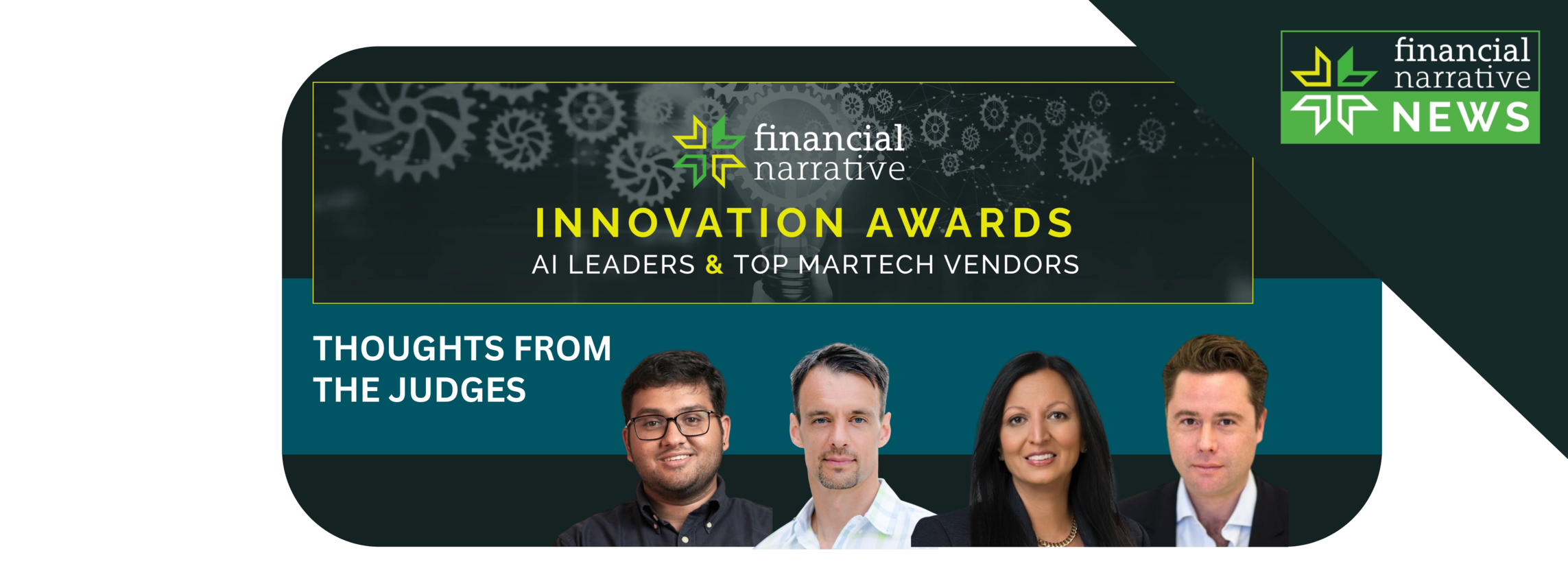
This year's independent judging panel brings together expertise from across academia, financial technology, and global platforms. We asked a few of them to share their thinking on what innovation really means in financial marketing, how to recognize true AI transformation, and why naming and celebrating this work matters.
What does genuine innovation actually look like?
Financial services has a well-earned reputation for caution. Regulation, trust, and complexity all slow the pace of change. But the judges see something different emerging in the strongest submissions.
For Kishan Panpalia, Co-founder and CMO at Pepper, the test is whether the work changes how an organization operates — not just how it communicates. "The difference between real innovation and playing it safe is whether the work changes the operating model," he says. "If AI or data is only being used to make existing campaigns slightly faster, that is optimization. But if it changes how insights are generated, how content is personalized, how customers are supported, and how marketing teams make decisions, that is real innovation."
Andrei Hagiu, Professor at Boston University Questrom School of Business, points to customer experience as the defining measure. Genuine innovation, he argues, goes beyond new creative campaigns to change how firms use AI and customer interactions to create value. The strongest examples use AI and digital platforms to deliver more personalized, timely, and useful experiences — while maintaining the trust and regulatory compliance that financial services demands.
Benedict Kingsmill, Business Lead, Financial Services, EMEA and LATAM at LinkedIn, offers a sharper frame: innovation in this industry isn't about taking more risk — it's about creating more value within the realities of a highly regulated environment. When evaluating submissions, he looks for measurable changes in customer behaviour, commercial outcomes, and scalability. "The best work solves a business problem, not a marketing one," he says. "Real innovation is scalable. If it only works as a pilot, it's an experiment. If it changes how the organization operates, it's innovation."
When does experimentation become transformation?
These three judges draw a clear line between organizations testing AI and those that have embedded it into how they work.
Panpalia identifies three markers. First, AI is connected to business goals, not just productivity goals. Second, teams are using it across the full journey — from research and strategy through to content, distribution, measurement, and customer experience. Third, there is governance, accountability, and a clear measurement framework in place. "At that point, AI is no longer a tool people are testing," he says. "It becomes a new way of working."
Hagiu frames the threshold in similar terms. A brand crosses that line when AI moves from isolated pilots into core internal decision-making and customer-facing products — when it systematically improves how an organization creates content, understands customers, allocates resources, or develops products, not just when it generates marketing copy.
Kingsmill sees transformation beginning when AI moves beyond content creation and into decision-making, measurement, and workflow design. The leaders he's watching aren't simply making existing processes faster — they're redesigning how marketing works. He also points to an emerging frontier: as AI shapes how content is discovered, the strongest organizations are already optimising for AI discovery alongside human discovery. "The proof is not in the technology itself," he says, "but in measurable business outcomes."
Why does recognition matter?
The case for naming and celebrating this work goes beyond industry awards. All three judges see public recognition as a mechanism for accelerating change across the industry.
Panpalia argues that the industry needs visible examples of what good looks like. "In financial services especially, many teams are trying to balance innovation with trust, compliance, and brand responsibility," he says. "Celebrating strong work gives others confidence that meaningful AI adoption is possible without compromising on those principles."
Hagiu sees it as a diffusion mechanism. Public recognition helps identify and spread best practices, encourages firms to invest in ambitious experimentation, and helps the industry learn from successful examples — accelerating the adoption of genuinely valuable innovations.
Kingsmill frames it in terms of cultural permission. Recognition gives others licence to innovate — creating visible proof points that responsible and ambitious marketing can coexist in a highly regulated industry. "Most importantly," he says, "it shifts the conversation from marketing activity to measurable business impact." Celebrating successful work raises the standard across the industry, making the case that innovation doesn't require compromising on compliance or trust.
Sheevani Raikundalia, Executive Head of Financial Services Advertising, North America at Bloomberg Media, adds that recognition signals what the industry values, not just what it has achieved. Awards highlight the teams using AI to solve real business challenges, but also the people willing to experiment, take thoughtful risks, and lead responsibly. "In a space evolving this quickly," she says, "that kind of recognition helps inform and inspire others as everyone is navigating what's possible."
Nominations close on Friday, July 3. The awards are open to all marketing and communications leaders across financial services. Whether you have built something worth sharing or know someone who has, we want to hear about it. Nominate now >>>
