

AI Search Is Eating Your Traffic: Why Financial Brands Must Rethink Visibility
Snapshot:
AI search is no longer a niche tool—it’s quickly reshaping how consumers seek information and interact with brands online. According to Datos, browser-based AI searches in the U.S. have grown more than fourfold in just 18 months, now accounting for 5.6% of desktop traffic.
Early adopters are even further along, with 40% of their search activity now happening via LLMs like ChatGPT or Perplexity. That’s eroding traditional search engine dominance and diminishing the impact of SEO-driven marketing as fewer consumers click through to brand websites. Publishers are already reporting steep declines in organic traffic, and marketers are scrambling to ensure they appear in AI-generated answers, which typically showcase only one response instead of a list.
BrightEdge data confirms a deepening split in AI search philosophy: Google acts like a research assistant, surfacing sources, while ChatGPT behaves like a trusted coach, recommending tools and next steps. In finance, this divergence is subtle but still significant.
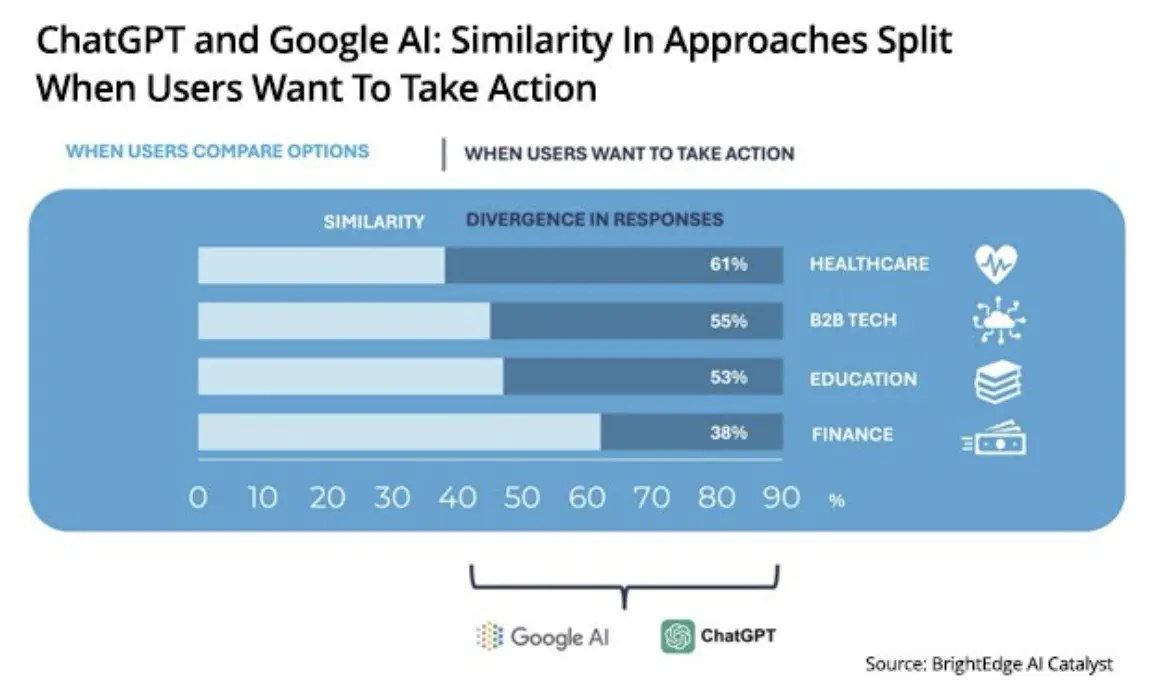
In finance, where divergence is the lowest among industries at 39%, ChatGPT tends to guide users toward budgeting apps like Mint and YNAB, while Google favors content hubs such as NerdWallet and financial blogs, reinforcing the contrast between ChatGPT’s tool-oriented coaching approach and Google’s information-rich assistant model.
This signals a major shift in how financial brands must think about content. Longer, question-based queries are more likely to trigger AI summaries on Google, but those summaries reduce clickthrough rates by nearly half.
Pew’s research shows that only 8% of users who see a Google AI summary click through to another site, compared to 15% for traditional results. Even more concerning, users are more likely to end their session entirely after seeing an AI answer. This means brand visibility is being squeezed from both sides. By fewer clicks in traditional search and by a single-answer economy in AI interfaces. T
Brands must now optimize not just for keywords, but for inclusion in AI-generated responses. Success depends on understanding the intent behind queries, creating decision-support content, and preparing for a future where “being found” looks completely different.
Full story: WSJ - Performance Marketing Insider