

Financial Narrative's 2026 Innovation Awards: AI Leaders
The votes are in! After evaluation by an independent panel of judges, we are pleased to announce the winners of the FNN Innovation Awards AI Leaders List 2026.
These seven leaders were selected for moving beyond experimentation to deliver real, measurable impact using AI to transform how they build brands, reach audiences, and run marketing and communications functions in financial services.
For this article, we asked each winner to share what they are doing with AI, and what it means for the future of financial services marketing.

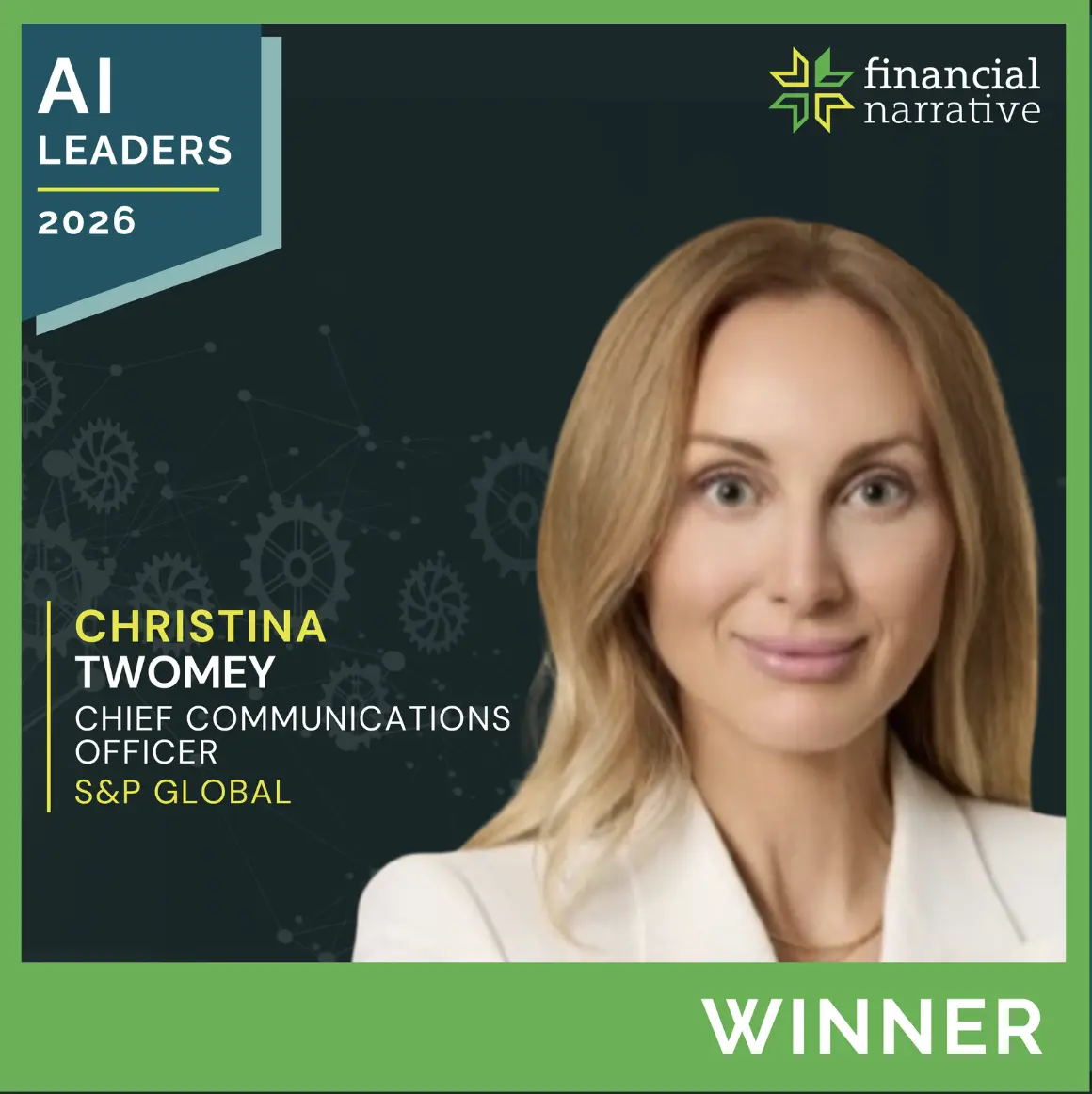 Christina Twomey, Chief Communications Officer, S&P Global
As Chief Communications Officer and a member of S&P Global's Executive Leadership Team, Christina Twomey has led a comprehensive transformation of the company's communications function embedding AI across the full lifecycle of planning, execution, and measurement, and redefining the role of communications from an execution function to a strategic driver of enterprise value.
Key to the initiative is Kensho Spark Assist, S&P Global's secure, governed internal AI platform through which Christina's team has built a library of custom AI applications known as Sparks that encode communications best practices, templates, editorial standards, and governance into reusable tools. These enable teams across S&P Global to generate communication plans, draft content, analyse data, and assess messaging risk with speed and consistency.
The results are substantial. Today, 100% of the Communications team actively uses AI, with 90% having built and deployed their own custom applications. More than 3,000 colleagues across the firm have executed over 33,000 AI-driven interactions using communications-built tools. Key processes have been reduced from hours to minutes, materially improving speed and output quality.
Critically, Christina has ensured that AI augments rather than replaces human judgement. Her leadership has been consistent: AI increases scale and insight, but credibility is protected through governance, editorial control, and disciplined execution. The time saved has been deliberately redirected towards narrative development, stakeholder intelligence, and leadership counsel — increasing the function's strategic contribution to the business.
Has AI changed the conversation about what communications is worth to the business?
Yes, AI is absolutely accelerating a broader shift that was already underway. We're in an intense moment where AI and agentic technology are transforming the way we operate and live as human beings, while organizations are also navigating geopolitical issues, reputational risk, and trust. The real value we bring is helping leadership teams ensure there's no daylight between a company's actions and its communications, anticipate risk, and see around corners. That's why you're seeing more CCOs with a true seat at the management table and why communications is increasingly viewed as a driver of long-term business and shareholder value.
When your team spends less time on execution, where does that time go?
We talk a lot about "dropping the sandbags" by automating the work that holds us back and doesn't require uniquely human judgment. The time we gain goes into higher-value strategic advisory work: helping leaders anticipate risk, challenge assumptions, think more creatively, and create greater business value. I increasingly use AI as a thought partner and sparring partner. The future isn't fewer people doing the same work faster; it is communications professionals working shoulder to shoulder with AI agents while focusing more of their energy on judgment, strategy, creativity, and trusted counsel.
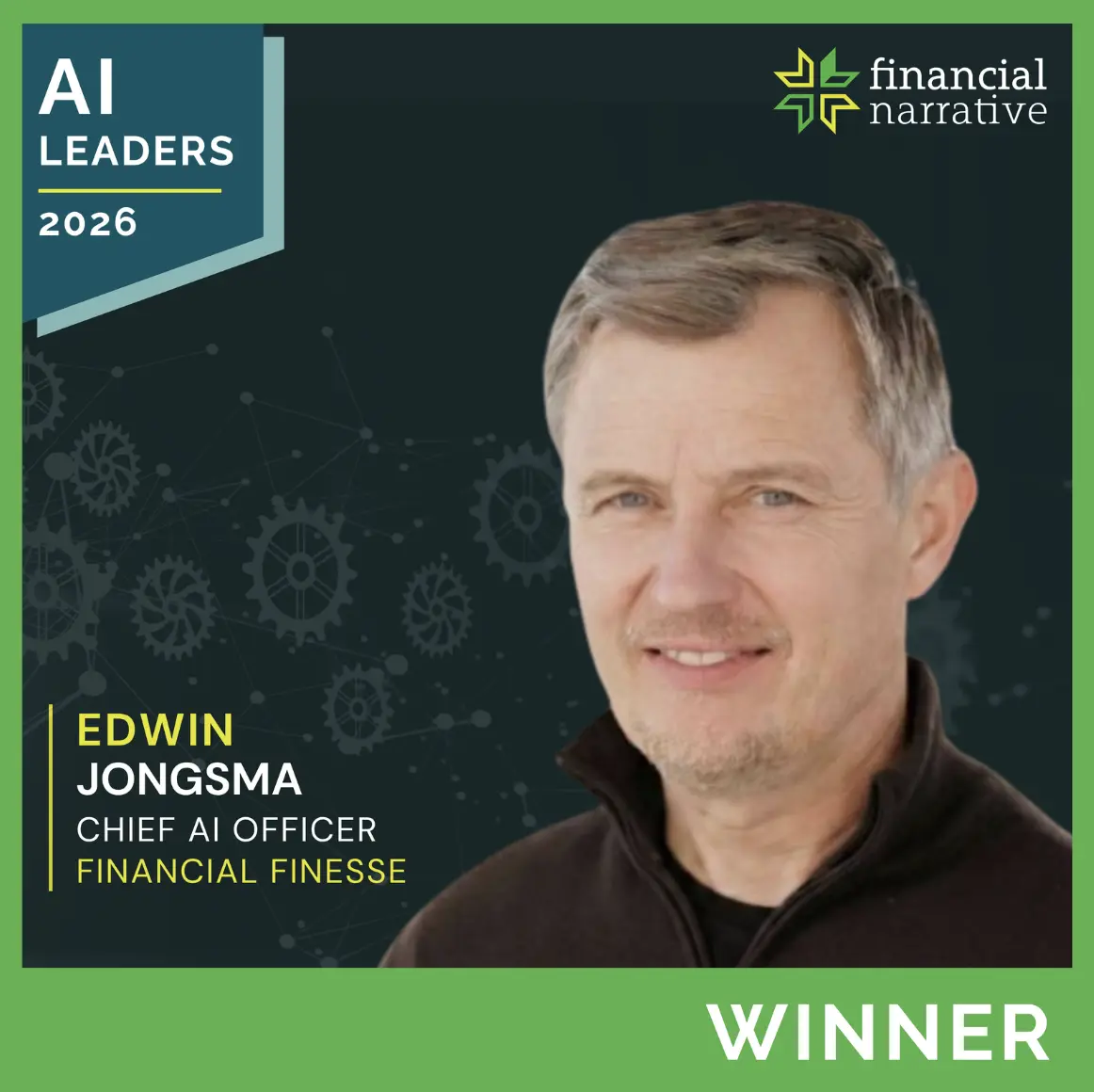 Edwin Jongsma, Chief AI Officer, Financial Finesse
Edwin Jongsma led the team that developed and delivered Aimee, a conversational AI financial coach that has fundamentally transformed how Financial Finesse communicates with and supports its users, scaling the expertise of its CERTIFIED FINANCIAL PLANNER™ professionals to reach millions of employees across multiple countries.
Long before generative AI became mainstream, Financial Finesse conceived of an AI-powered coach that would allow users to interact directly with its content library and receive deeply personalised, benefits-aware guidance. Edwin led the team that turned that vision into Aimee AI Chat, now live in 2026 following a major rebuild, which coaches employees through real-world financial decisions, from evaluating a 401(k) loan to choosing between health plan options, drawing on a proprietary Knowledge Vault built from 27 years of CFP® expertise and each employer's own benefits data.
The results demonstrate material impact. Employees using a benefits-integrated platform are significantly more likely to be on track for retirement, maintain emergency savings, and capture their full employer match. Financial resilience increased by 79% among users of the benefits-integrated experience compared with 55% among those without.
Edwin's approach to responsible AI is distinctive: Aimee operates as a closed, proprietary system never drawing from the open internet with every recommendation traceable to a specific expert-authored source. Every interaction includes a direct path to a live CFP® professional, positioning AI as the front door to guidance rather than the final word.
Under his leadership, Financial Finesse has also developed a proprietary AI-powered global content generator enabling the launch of Financial Wellness Hubs in 20 additional countries in Q3 2026 alone at an estimated cost saving of at least 10x compared with manual localisation.
Trust is everything in financial services. How do you build a brand around an AI product when the stakes are personal?
For us, it really comes down to who's actually behind the answers. Everything Aimee knows comes only from our own coaches and their employer's benefits documents. Our coaches are CFP®'s with a decade or more of experience, but they're also real people who get that money isn't a math problem; it's deeply personal, and unique to the individual.
AI alone can't get to the question behind the question the way a human can, so we built our model to be written, reviewed, and maintained by coaches, not pulled from random forums or outdated blog posts, because one wrong answer about someone's retirement account isn't a small thing. Coaches build the knowledge, Aimee delivers it, and if something falls outside what she's confident about, she hands it off to a live coach who can see exactly where the conversation left off.
That's the part people don't always think about with AI in finance: it's not really about the AI at all, it's about who's standing behind it. So the brand isn't "look, we have AI." It's "look who is behind this, it's real financial experts who won't try to sell you a thing." When people understand that, that's when they relax and actually engage with it.
How has AI changed how you drive engagement with an audience that didn't come looking for you?
Most people don't go looking for financial guidance until something forces the issue. A stressful bill, a life change, open enrollment season — something that makes the money stuff impossible to ignore anymore. Otherwise, it's easy to push off, especially when there's already a lot going on.
So the way you earn engagement with people is by making it personal and making it safe. They need to know it's confidential, that what they're getting is accurate, and that it's actually worth their time, not just another notification to swipe away. AI has helped us do that through point-of-need communication, meeting someone at the moment with something that actually matters to their life, instead of hoping they eventually come find us. A nudge when they're eligible to bump up their retirement contribution. A heads-up before an enrollment deadline hits. Something specific to their situation, not a generic email blast.
They have to feel seen, and AI scales our ability to do that on an individual level. This helps close the gap between knowing and doing. A lot of people aren't struggling because they lack information; they're struggling because taking action feels like one more thing on the to-do list. When someone feels seen, they're more engaged.
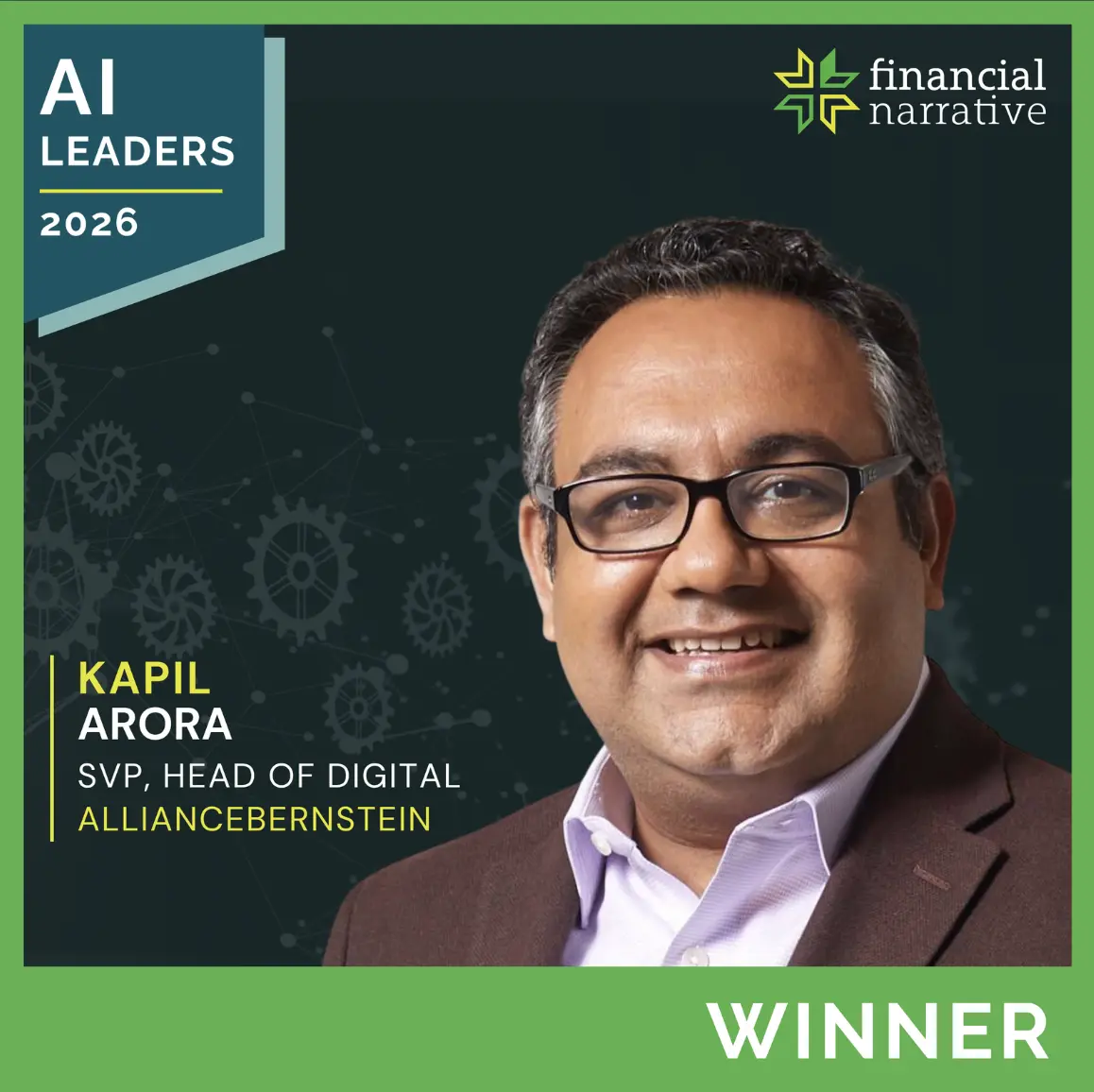 Kapil Arora, SVP, Head of Digital, AllianceBernstein
Kapil Arora has led a far-reaching transformation of AllianceBernstein's digital marketing and client engagement capabilities, successfully transitioning AI from isolated experimentation into enterprise-grade, heavily governed deployment across content creation, digital discovery, campaign execution, and sales enablement.
His flagship initiative — AI-powered search — transformed the search experience on AllianceBernstein's U.S. Retail website, replacing the legacy keyword-based approach with a natural language understanding and AI-powered layer. Rather than returning a list of links, the system now interprets the intent behind complex financial queries and delivers curated, conversational responses drawing from research, products, and thought leadership. The result was a 2.5× increase in user engagement on complex queries, enhanced client self-service, and recognition with the FCS Portfolio Gold Award.
Beyond search, Kapil's leadership spans a portfolio of interconnected AI initiatives: English research assets are automatically transformed into multilingual audio and video formats, eliminating manual translation costs; an AI Digital Twin enables real-time, multilingual client interrogation of institutional research without the need for scheduled executive engagement; and a firmwide AI and Automation Working Group has streamlined campaign brief generation and automated planning cycles.
Throughout, Kapil has navigated the significant regulatory complexity of deploying generative AI on client-facing surfaces in a regulated financial environment — ensuring compliance sign-off, human-in-the-loop review protocols, and rigorous data governance at every stage.
You shifted from broadcasting content to letting clients engage with it on their own terms. What does that mean for content strategy?
AB has always been known for the strength of its thought leadership and research. Our content teams produce timely, relevant perspectives and work hard to make sure those insights reach clients through the right channels. As preferences change and our content strategy evolves, we're changing how we think about the experience around that content. It's no longer enough to create a great piece of research and simply broadcast it to everyone.
We have to create flexibility that empowers clients to engage with our thinking on their own terms. It starts with diversity of format. The same underlying research insight might be delivered through a blog post, podcast, short video, social post, email, newsletter or the content platforms of our distribution partners. The idea isn't to make clients adapt to how we publish; it's to adapt our content so that it satisfies their wide-ranging preferences for consuming information.
We've also evolved search to make it easier for clients to find content on their own, without needing to know our terminology, taxonomy or exactly where a specific piece of content lives. They can use natural language to explain what they are looking for and be connected to relevant AB perspectives from across the site. So, for me, the shift in content strategy is moving away from "What content do we want to distribute?" to "How does a client want to engage with our thinking?" Great content remains the foundation, but our job is increasingly to remove the friction between clients questions and interests and the insights that can help them.
What are financial services brands still getting wrong about how clients find and engage with their content?
One of the things financial services brands need to be careful about right now is equating the ability to produce more content with the actual need to produce more content. AI has made content creation faster and easier, and that naturally creates an opportunity to increase the volume of content we produce. But I don't think more content by itself is the answer.
Content is still critical, but the relevance and quality of that content — and the experience around it — are becoming even more important. If everyone can create more content, the real differentiator becomes whether clients can find the right information, trust in its authority and credibility, and engage with it in a way that makes sense for them.
We must also move away from the worldview that the website is the primary place where clients encounter and consume our thinking. Clients don't see these as separate channels; they're all interactions with the same brand, and clients determine where and how deeply they engage. Consistency is particularly important in financial services because our business is built on trust. Clients are looking for credible information that helps them understand an issue, answer a question or make a better-informed decision. It's our responsibility to make that information relevant, easy to find, accessible and reliable wherever they choose to engage with us.
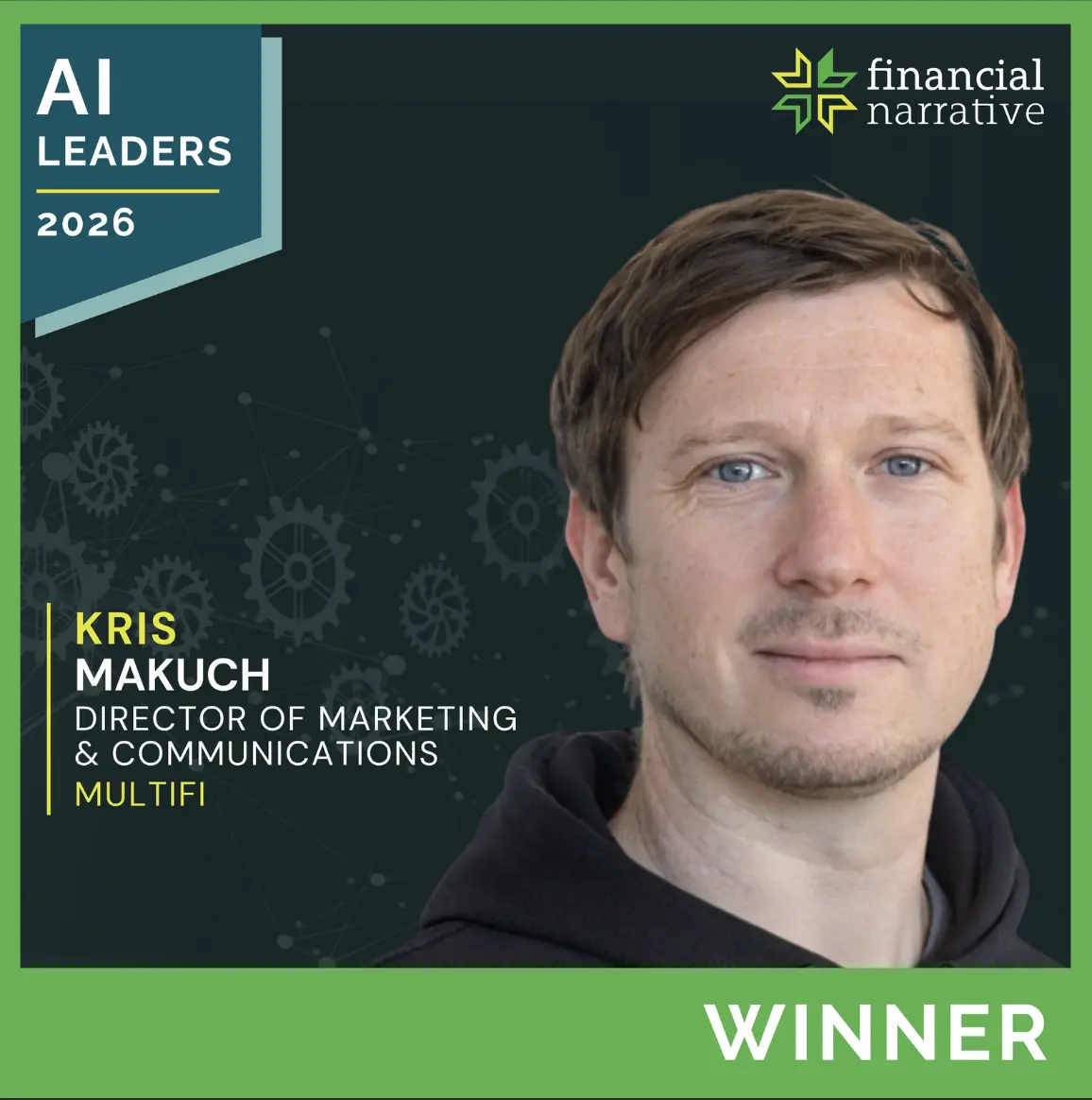 Kris Makuch, Director of Marketing & Communications, multifi
Kris Makuch has applied AI across two parallel tracks, financial services operations and institutional intelligence, in ways that go well beyond conventional marketing automation.
At multifi, Kris led the organisation's participation in the FCA AI Supercharged Sandbox, developed in collaboration with NVIDIA, Amazon Web Services, and NayaOne. He and the team identified and scoped a solution to one of Open Banking's most significant unsolved problems: 90% of transaction data arrives uncategorised or incomplete at the point of credit assessment, rendering it effectively unusable without manual intervention. Over 900 hours across 17 tested approaches and eight methodological phases, multifi developed a five-stage AI pipeline that ingests, cleanses, and enriches raw transaction data entirely within multifi's secure infrastructure. The results were presented at the FCA Sandbox Showcase in January 2026: transaction categorisation improved from 10% to 85%, and credit decision turnaround was reduced from 48 to 24 hours, creating a demonstrable pathway to fairer lending outcomes for UK SMEs.
Alongside this, through his AI consultancy W'A.I Studios, retained by the Centre for Economic Security, Kris has designed and operated live AI intelligence infrastructure for senior government, defence, and finance audiences, and built automated daily intelligence monitors that synthesise economic security intelligence across multiple sources at near-zero marginal cost.
What should marketing actually own in a modern financial services organisation?
Marketing tends to succeed when it stays close to the relationship between user and product. In financial services, that responsibility is amplified — you're the custodian of trust, operating in a space where poor decisions have real consequences for people's businesses and livelihoods. AI has expanded what marketing can access and automate, but it's also made the human judgment layer more important, not less. Someone has to own the voice of the end user. In financial services, that has to be marketing.
What can marketers do now that simply wasn't viable two years ago?
Marketing can now inform business decisions at a level beyond previous capabilities. We are finally seeing the move from vanity data into one that offers valuable insight at an operational level, LLMs being a perfect example. This new channel bridges the gap between broad brand awareness and direct response media allowing the social signals of a brand to more accurately serve the needs of the consumer in a highly personalised environment. If a product or service is sold via a recommendation from an LLM, then a marketeer can begin to demonstrate campaign value well beyond the typical marketing funnel.
Furthermore, the opportunity for marketeers to drive valuable brand engagement in this channel is the single biggest advance within the marketing arena that simply wasn't accessible two years ago. We saw this first-hand at multifi, within five days of deploying a technical framework to improve our LLM visibility, we received our first unprompted ChatGPT citation as a recommended UK revolving credit provider. That's a channel two years ago that simply didn't exist.
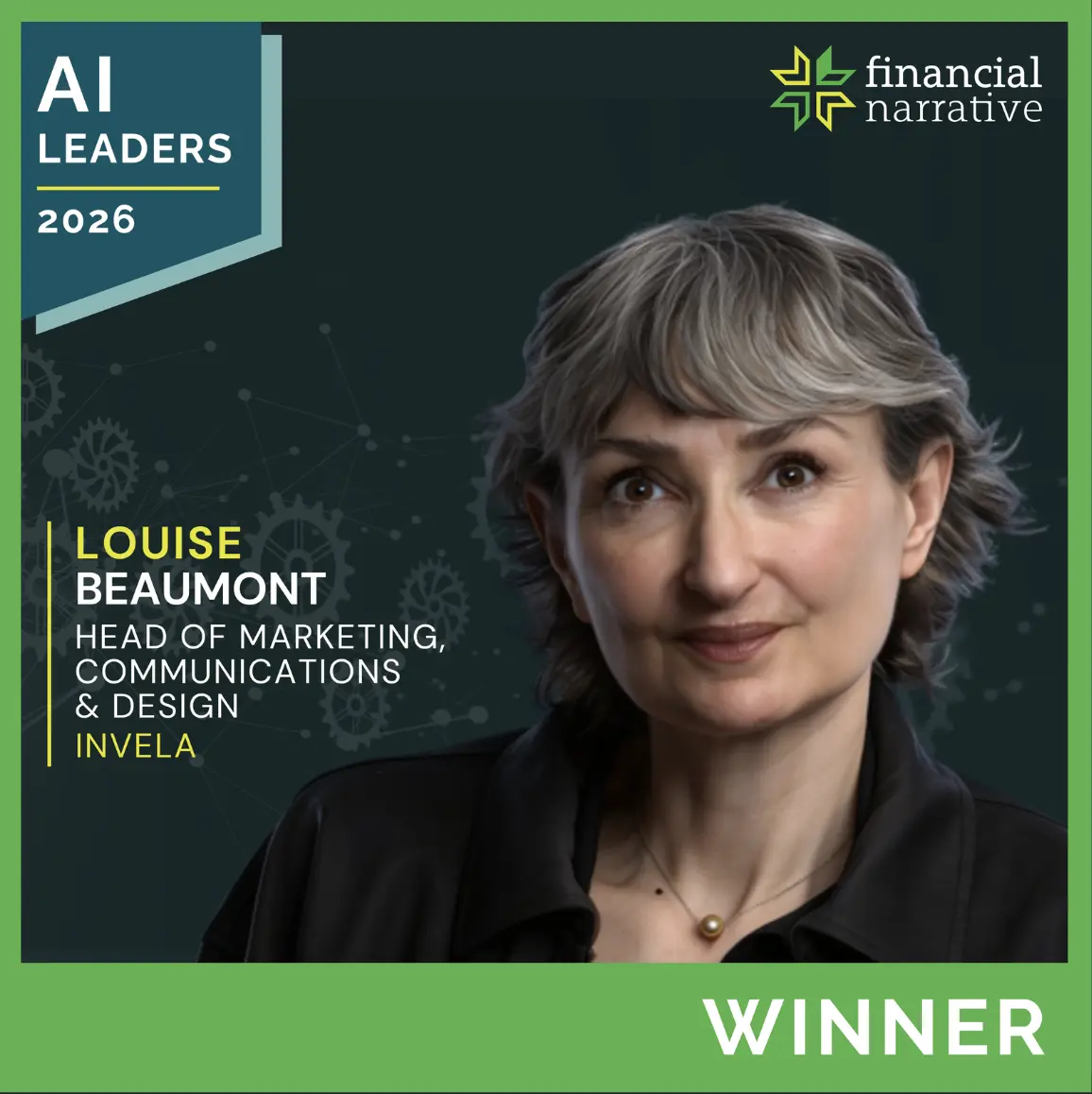 Louise Beaumont, Head of Marketing, Communications & Design, Invela
Louise Beaumont has built something rare: a three-person marketing, communications, and design team running a growing suite of in-house AI agents — built and governed entirely in-house — as the operational backbone of Invela, a scaling open finance risk management company.
Through sustained, iterative agentic development (1,197 commits over 74 days), Louise, Evan Navarro, and Lee Bergman built nine agents comprising roughly 131,700 lines of code — replacing what would otherwise require a significantly larger team and multiple enterprise subscriptions. These include an automated daily intelligence monitor covering up to 99 regulatory and trade press sources, an in-house LinkedIn insights tool tracking 2,992 engagements across 820 distinct industry professionals, and a custom image and video generator producing on-brand assets at cents per image.
One standout example is Persona Lens, known internally as Agent Edna: an AI-powered tool that pressure-tests marketing content against 14 distinct buyer personas — including CISOs, Chief Risk Officers, and regulators — returning a structured scorecard across six weighted categories. Every run is fully auditable, with inputs, model responses, and a timestamped audit trail logged end-to-end. Louise built the underlying persona profiles herself, grounding each critique in real audience intelligence rather than generic assumptions.
The numbers back it up: to date, the suite has saved an estimated $50,000–$65,000 in external spend and avoided roughly $160,000 in additional headcount costs in the first six months.
What sets this approach apart isn't just the output — it's the discipline behind it. Every tool runs on a non-bypassable audit trail, produces structured rather than freeform outputs, and keeps a human as the final arbiter of what ships.
What does your team's experience mean for how marketing leaders should think about building their functions?
The old assumption that headcount is the only lever you have — that scale means people — is one that we've proved to no longer be true. A three-person team built and ran nine in-house agents doing the work that would otherwise need a much larger team and a stack of enterprise subscriptions, and it happened in 74 days because we owned the build ourselves rather than waiting on vendors' roadmaps.
But the lesson isn't "replace people with AI." It's that marketing leaders now have a real choice about where human judgement adds value and where it doesn't. Monitoring proliferating sources, tracking thousands of engagements, generating on-brand assets at scale — none of that needs a person doing it manually. What still needs a person is deciding what's true, what's on-strategy, and what ships. For leaders building lean functions, the practical takeaway is to think in terms of capability, not category. Don't ask "do we need another hire" — ask "what decision or output are we actually trying to produce, and what's the most efficient, most auditable way to produce it."
What has pressure-testing content against real audience intelligence changed about what you actually publish?
It's killed a lot of content before it ever went out — which is exactly the point. Agent Edna doesn't just tell us if something reads well; she tells us how a CISO, a Chief Risk Officer, or a regulator would actually react, against profiles grounded in real audience intelligence rather than a generic buyer persona template.
That's a very different bar than "does this sound good to a marketer." The biggest shift is that we've stopped writing to please ourselves. Running content against 14 distinct personas and a weighted scorecard forces us to see our own blind spots — where language is too fluffy, where a claim would read as overreach to a regulator, where something that sounds authoritative to us would sound naive to a Chief Risk Officer. Practically, it's changed our tone more than our topics: more precision, less assertion; more acknowledgement of nuance and trade-offs, less of the confident-sounding generic claims that don't survive scrutiny from a technical or regulatory audience.
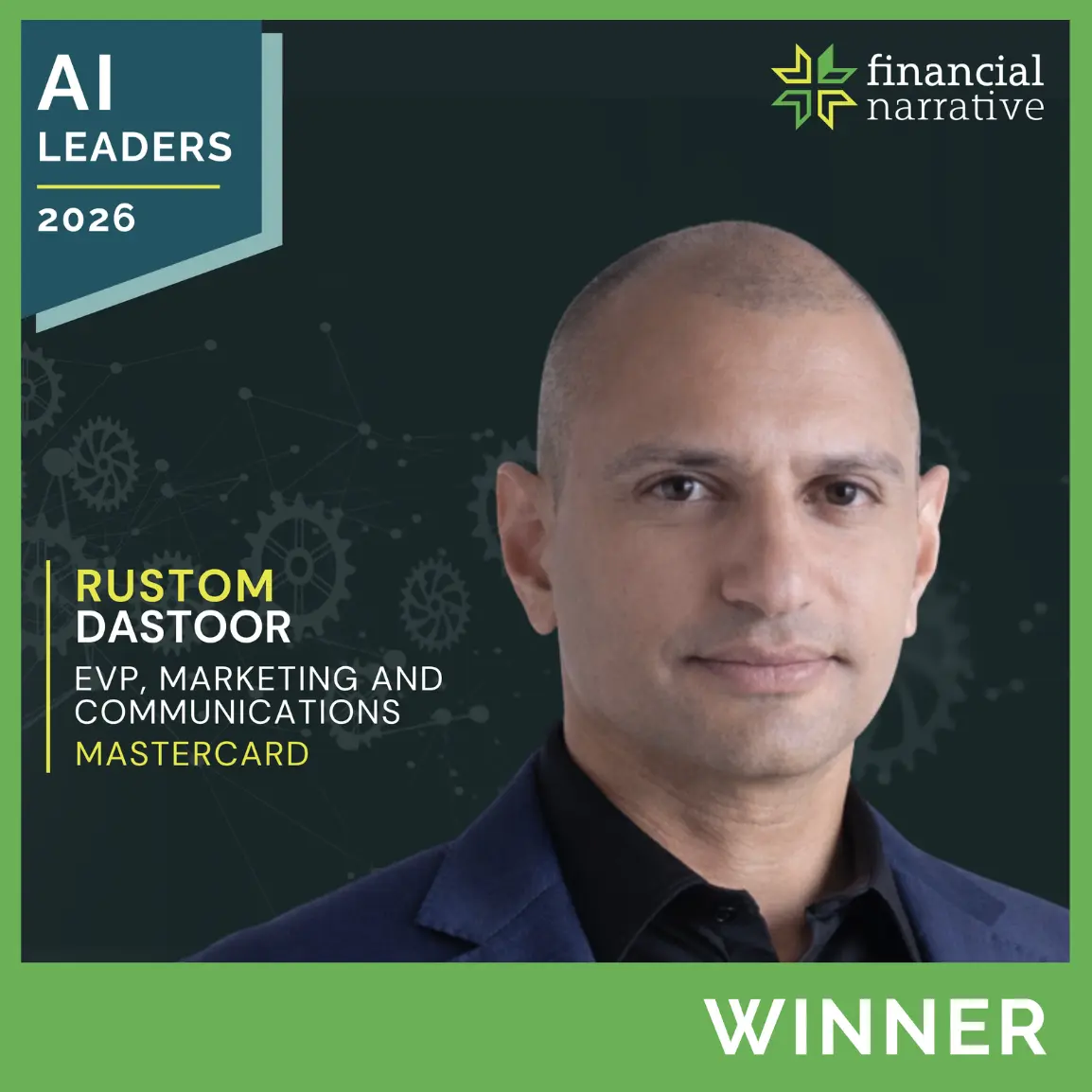 Rustom Dastoor, EVP, Marketing and Communications, Mastercard
Rustom Dastoor set a mandate that challenges a fundamental assumption in market research: that insights should be built on studying what worked yesterday. His response was the Consumer Collective — a proprietary, always-on platform that fuses first- and third-party research data with generative AI to deliver moment-of-need intelligence to marketing and business teams across the Americas.
The Consumer Collective combines more than 60 synthetic personas — built from consented research inputs and real-world behavioural signals — with a natural language chatbot interface, enabling teams to pressure-test value propositions, creative concepts, and go-to-market plans against specific audience segments in real time. Rather than waiting weeks for traditional research, teams can now get structured, AI-generated audience feedback instantly, at zero operational cost per run.
The platform has been deployed across five Americas markets — the US, Canada, Mexico, Brazil, and Colombia — and has delivered measurable commercial impact: the Insights & Intelligence team gained approximately 20% additional capacity in a single quarter, customer engagement increased 2.5 times in the same period, and the Consumer Collective has become a key differentiator in quarterly business reviews, RFPs, and executive briefings.
Responsible AI was embedded from the outset: the platform cleared Mastercard's AI governance programme, integrates three leading large language models to reduce single-model bias, and carries a plain-language AI disclaimer on every output.
How has access to real-time audience intelligence changed what marketing can deliver to the business?
Real-time audience intelligence has the potential to fundamentally elevate marketing's role — from a communications function to a decision intelligence function for the business. By combining real-time customer signals with data, AI and automation, marketing can understand not just who customers are, but what they need, what they are likely to do next, and what actions the business should take. That intelligence can inform decisions well beyond media and messaging — shaping product development, sales priorities, customer experience and even where the company invests. The opportunity is to move marketing up the value chain: from using data to optimize campaigns to using intelligence to help the entire enterprise make faster, smarter, more customer-led decisions that drive growth.
AI is increasingly influencing how brands get discovered and chosen. What should financial services marketers be doing about it?
AI is fundamentally changing the point of preference. Increasingly, preference is being formed before the buyer is even aware of the options — the AI is choosing, shortlisting and providing the rationale. That means marketers need to get comfortable influencing the intermediary: the AI itself. In financial services, that requires a new layer of marketing capability: organizing proprietary data so LLMs can access and interpret it, creating authoritative machine-readable content, connecting databases and APIs into the environments where AI agents operate, and investing in technical branding — ensuring the brand is differentiated, understood and preferred inside the algorithm. The next competitive battleground isn't just share of mind or share of search; it's share of recommendation.
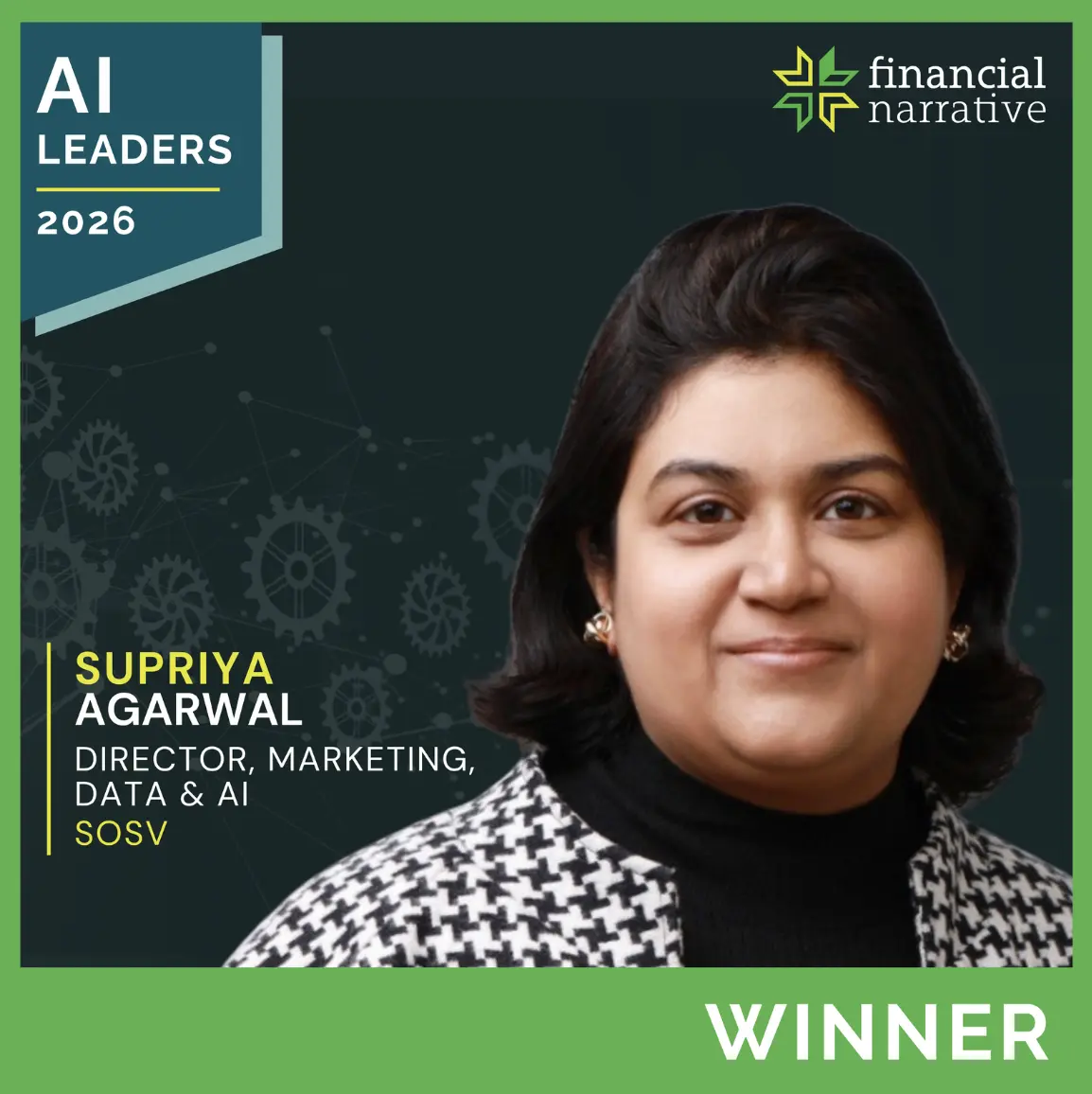 Supriya Agarwal, Director, Marketing, Data & AI, SOSV
Even before the current wave of generative AI, Supriya Agarwal recognized the importance of trusted, well-governed, context-rich data, a principle that would become increasingly critical in the AI era. She built Atlas, SOSV's investor audience intelligence platform, based on the conviction that AI's greatest value comes not from the model alone, but from combining it with trusted proprietary data.
Atlas integrates first-, second-, and third-party data with proprietary signals, including event engagement, co-investment activity, relationship history, and investment preferences. Its feedback loop incorporates new engagement signals, enriching the context available for future audience decisions.
The operational impact has been significant. Targeted investor lists that previously required 20–35 business days to build can now be generated in under five minutes. Atlas has supported audience development across 16 Demo Days and Investor Showcases featuring 200+ deep-tech startups, as well as thematic VC-Founder Matchups and specialized investor events.
Investor engagement has also strengthened. Across SOSV's VC-Founder Matchups, average meetings per investor registrant increased 69% and repeat participation increased 120%, with Climate and Health Matchups seeing improvements of 91% and 39%, respectively. While these results reflect the broader evolution of the events, Atlas provides the data and context to identify and engage relevant investors at scale.
As generative AI advanced, Supriya helped expand SOSV's AI capabilities by applying LLMs across Atlas and other internal sources, surfacing insights grounded in organizational context that external data sources alone cannot provide.
You built your own audience intelligence rather than relying on third-party data. What has that changed about how you market?
It has changed the speed, scale, and confidence with which we can market. Third-party data can be useful, but it is often incomplete, outdated, or missing the context that makes it actionable. By building our own audience intelligence and continuously enriching it with signals from our programs and interactions, we've created a feedback loop that gets smarter over time. We're not just capturing who our audience is, but building context around their interests and engagement with us. That allows us to identify and engage the right audiences much faster, scale programs that would otherwise require significant time and manual research, and query our data with greater confidence. That reliability is especially important in the age of AI, because AI is only as useful as the data and context you give it.
What are marketers missing by not owning their data infrastructure?
I don't think every marketer needs to own or understand the technical details of data infrastructure. Marketing is a broad discipline, and the level of technical fluency needed will vary by role. But marketers can no longer afford to treat data and AI as someone else's domain. They increasingly shape how we understand audiences, personalize experiences, measure performance, and scale. Every marketer should be data and AI aware, even if they are not technical, and marketing as a function needs a seat at the table when decisions about these capabilities are being made. You don't necessarily need to build the infrastructure, but you should understand enough to ask the right questions and help shape what it enables.
CONGRATULATIONS TO OUR WINNERS!
JOIN OUR AI SEARCH SERIES
