

CMO Collective Tackles Trust and Growth at Future Proof Festival
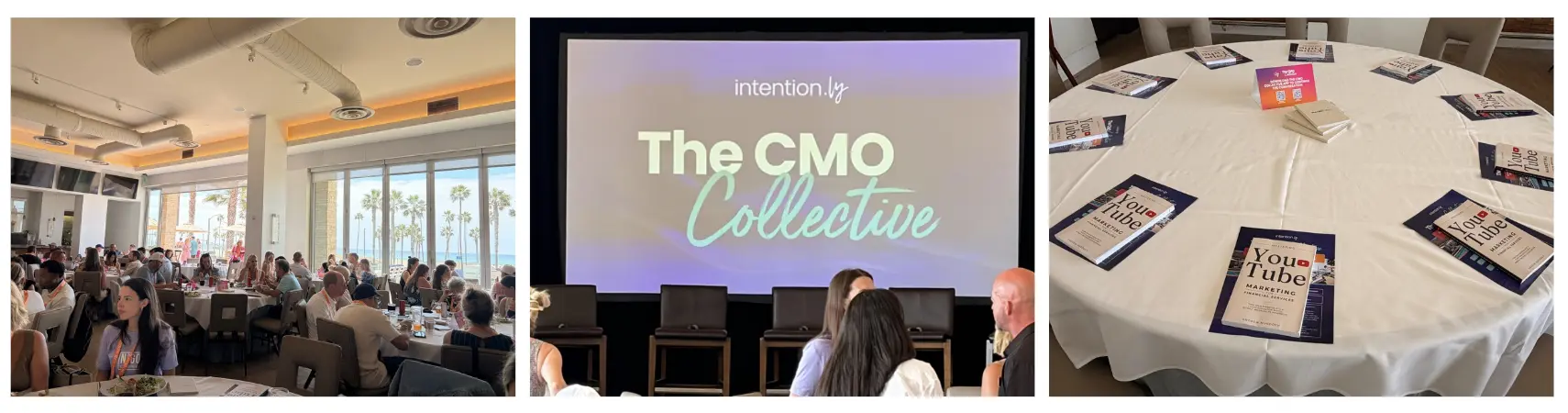
Marketers packed out the CMO Collective event hosted by Intention.ly on day three of Future Proof Festival in Huntington Beach, for two panel discussions on what's driving growth in financial services marketing right now: credibility building, client reviews and video.

From Visibility to Believability: How Brands Earn Trust Now
Attention is no longer enough. In today's market full of similar claims and polished messaging, financial services marketers need to build believability. This discussion focused on how firms are establishing real credibility through a clear point of view, strong client experiences, and advocates willing to speak on their behalf. Joe Steuter, Chief of Client Strategy at Intention.ly, moderated a discussion with Jason Lahita, Founding Partner at StreetCred; Whit Lanier, Founder and CEO of Amplify Reviews; Dimple Shah, Managing Director at Humanity Labs; and Joanna Irwin, CMO at HB Wealth.
PR as credibility marketing. Lahita opened with a reframe: PR is "credibility marketing." The difference between chasing media attention and building real credibility, he said, is consistency. Firms that show up in front of reporters week after week get treated as expert sources, and journalists project that credibility to their audiences as third-party validation. Anyone can email a reporter, he said. What separates a PR firm is doing it daily and understanding what each outlet and reporter wants.
Testimonials vs. reviews. Lanier drew a distinction marketers often blur: a testimonial, under the SEC's definition, is any opinion shared by a current client, in any format. An online review is specifically a one-to-five star rating and comment. His recommendation: capture testimonials in review format, offer every client an equal chance to leave one, and publish the solicitation policy publicly. That transparency helps with consumer trust and gives compliance an easy answer if an auditor asks how reviews are sourced.
HB Wealth's reviews playbook. Irwin gave the most detailed account of running a reviews program. HB Wealth, a $33 billion RIA with 10 offices across five states, launched with Amplify Reviews two years ago. She started with seven pilot advisors who could opt out at any point. The rules: every client got the request, no cherry-picking, but clients had to be with the firm at least six months, have a signed agreement and a funded account. Terminated clients and anyone with a conflict of interest were excluded.
Results after seven waves: 694 reviews collected, 99% five-star, response rates of 15% to 22% per advisor with no reminder emails sent. HB Wealth now publishes reviews on individual advisor pages along with an AI-generated summary of each advisor's feedback. Search ads using a client review saw double the click-through rate of ads without one. Inbound website leads were up 57% in the first half of this year over the same period last year, though Irwin cautioned that isn't attributable to reviews alone.
The program has also become a retention and succession tool. Retiring advisors introduce clients to their successor by pointing to that successor's reviews. Irwin said the entire program has drawn exactly one complaint: a client who asked to have a review removed after not realizing it would be published.
From known brand to unknown category. Shah offered a different kind of credibility problem. She recently moved from Osaic, a large, established platform, to Humanity Labs, an AI workforce startup for wealth management firms that most of the market has never heard of. The challenge shifted from managing a known brand's reputation to building awareness for an entirely new category. Her approach: let partner success stories do the talking rather than sales pitches, and measure success through new partner count and revenue growth rather than tracking individual campaign metrics.
No single channel wins alone. Steuter pushed back on a takeaway some attendees drew from Michael Kitces' talk the day before, that firms should find one channel that works and put all their budget behind it. The panel's view: most buying decisions take five to seven channels working together over time, not one.
Closing advice. Shah told marketers to lean on partner success stories and referrals. Lahita said don't fear PR, and compared media coverage to a doctor's diploma on the wall: it reassures clients, helps convert prospects, and boosts internal team morale. His framing: build the marketing plan and brand message first, then use PR as the amplifier.
Momentum Over More: The Tactics Driving Growth Now
Firms driving sustainable growth prioritize focus over volume. The second discussion covered practical strategies marketers are using to determine what audiences really need. Moderated once again by Steuter, the panel featured Kelly Vives, CMO at Allspring Global Investments; Rishi Bharathan, CEO of WiserAdvisor and Indyfin; Tyler End, CEO of Retirable; and Andrew Murdoch, Founder and Chief YouTube Officer at YT Era.
Segmentation at scale. Vives leads marketing for Allspring, a $600 billion asset manager operating in more than 40 countries, a brand turning five years old this November after being carved out of Wells Fargo's asset management business. Her approach to a firm that large: segmentation. Allspring can't chase growth in every country and every channel at once, so the team picked specific priorities, with US wealth and the RIA channel as the current focus, which is why the firm has a booth at Future Proof and its CEO is speaking on a later panel.
Filtering the idea pipeline. That same discipline applies to fielding ideas. Vives fields pitches from 350 salespeople globally. Her filter: the annual marketing plan sets the focus channels, countries and investment strategies in advance, and anything outside that scope gets deferred rather than argued about in the moment. When a piece of content underperforms, she uses the data to close the conversation. Her example: "Eight people read that piece, so we're not doing that again."
AI needs training, not just access. On AI, Vives said the tool requires real-time investment to use well, not just adoption. She's seen figures suggesting it takes roughly 90 hours of practice before a team member uses AI effectively, and argued firms need to budget for training, not just software. Her top current use case is hyper-personalization in outreach. She recommended every marketer in the room run an AI reputation check on their own firm: search the firm's name across ChatGPT, Google AI Overview and other engines, and see what surfaces, noting that Reddit is a heavily weighted source for many of these tools.
Reviews as a trust signal. Bharathan said he's watching consumer research behavior shift away from directory-style lead-gen platforms toward AI-forward search, which he sees as an opening for smaller RIAs to build visibility without big ad budgets. On reviews specifically, he argued that a mix of five-star and lower-rated reviews is more convincing to prospects than a uniform five-star record, because it reads as authentic rather than curated. His framework for prioritizing new tactics: distinguish between decisions that are hard to reverse and decisions that are cheap to test and back out of. Reviews fall in the second category, so there's little reason not to try them.
A narrow ICP as strategy. End runs marketing at Retirable, which targets a narrow demographic: 60- to 70-year-olds with under $500,000 in retirement savings. Every channel decision gets filtered through whether it reaches that specific group, regardless of how well it performs generally. He borrows an MVP mindset from product development to test new channels cheaply before scaling spend. Retirable screens all client and prospect calls with AI, and found that a prospect mentioning an advisor's name from a review during the first call is close to a guaranteed conversion signal, even when that prospect ends up working with a different advisor. On AEO, End said he doesn't know yet what tactics will define success in this space three to six months from now, and suspects the answer will look a lot like basic SEO. His advice: test now rather than wait for the data to be clear, and trust the marketing team's instincts in the meantime.
YouTube as a trust-building funnel. Murdoch's core point on YouTube: advisors fail by making videos they want to make instead of videos their target viewer wants to watch. He distinguished an advisor's client base and their YouTube viewer base, the latter being a much wider funnel. He tied long-term video strategy to the "mere exposure effect," the psychological finding that trust correlates with time spent in front of someone. The tell that it's working, he said, is a prospect saying "I feel like I already know you" on a first call.
His practical AI workflow tip: don't let AI write the script from scratch. Record yourself talking through the topic in your own words and stories first, then feed that raw transcript into AI to restructure into a YouTube-optimized script. He also said a database of more than 300 advisor questions about content and YouTube marketing he's collected contains zero mentions of AI, suggesting advisor audiences care more about content fundamentals than AI hype.
Who should skip YouTube? Murdoch's advice: advisors two to three years from an exit with no succession plan for the channel, and anyone who genuinely dreads being on camera.
More CMO Collective and Intention.ly at Future Proof Festival on LinkedIn.
>>> More Future Proof Festival 2026 for Marketers <<<
NOMINATIONS ARE OPEN
Nominated by our community and evaluated by an independent panel of judges, the 2026 awards will recognize the most interesting, innovative, and influential leaders delivering outstanding results and shaping the industry. Meet the judges and nominate >>>
