
Future Proof Festival: Allspring's Tina Schippers on What Moves the Needle at Events
Tina Schippers, Head of Strategic Events & Sponsorships at Allspring Global Investments, spoke with Financial Narrative News at Future Proof Festival, held September 14 to 17 in Huntington Beach, California.
With more than 25 years of experience leading event marketing and corporate engagement strategies across JPMorgan, Morgan Stanley, Lehman Brothers, the New York Stock Exchange, and Intercontinental Exchange, Schippers has built a career creating experiences that strengthen relationships, elevate brands, and drive business outcomes. In the interview, she shared her perspective on what differentiates impactful events, how AI is reshaping event planning, and where investment matters most.
The personal touch is the whole strategy
Schippers believes that while the event landscape has become increasingly crowded, meaningful human connection continues to be the strongest driver of business development.
She pointed to comments made by Allspring CEO Kate Burke during a Future Proof panel discussion, where the importance of face-to-face engagement emerged as a recurring theme.
"I loved hearing that," Schippers said. "In-person events remain one of the most effective ways to build trust, deepen relationships, and move business forward."
What makes an event stand out
Over the course of her career, Schippers' perspective on event success has evolved.
"Earlier in my career, I thought success was about securing the most sought-after speaker or the most prestigious venue," she said. "Today, I see it as the combination of compelling content, relevant speakers, thoughtful environments, and a seamless attendee experience."
She described the attendee journey as extending far beyond the event itself, beginning with registration and continuing through post-event follow-up. Delivering a high-touch, personalized experience at every stage is what ultimately creates lasting impressions.
Schippers also highlighted the collaborative nature of the financial services events community, noting that industry events provide valuable opportunities to learn from peers facing similar challenges and opportunities.
Building a booth with the help of AI
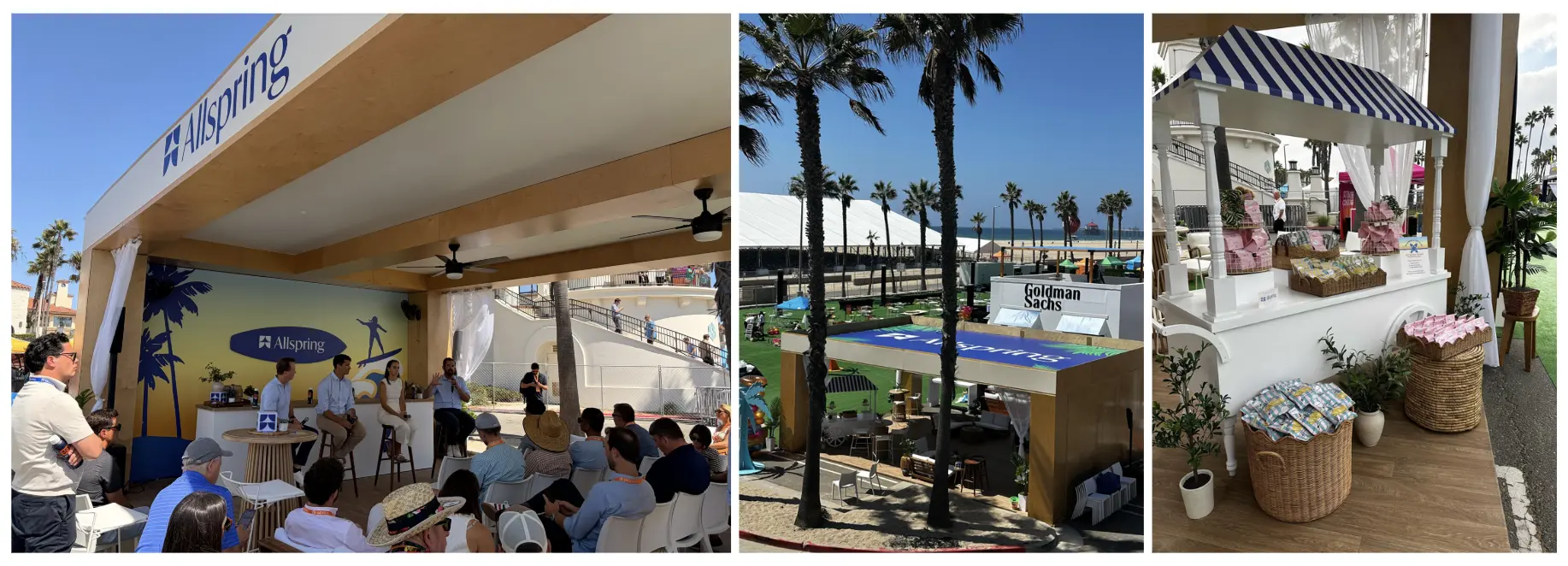
Allspring's Future Proof presence has grown from a small booth four years ago to a 20-by-30 setup on the main boardwalk.
This year, Schippers and her team incorporated AI into the booth design process, using generative tools to visualize concepts, evaluate layouts, and accelerate creative development.
"AI helped us explore ideas more quickly and thoughtfully," she said. "Ultimately, the goal was to create a space that reflected our brand: approachable, authentic, and relationship-focused."
The booth featured interactive experiences, including an AI-powered photo activation that placed attendees on a virtual surfboard in the ocean. Giveaways ranged from playful items such as Swedish candy to premium gifts reserved for client engagements, reflecting a tiered approach to attendee engagement. Some of the physical decor, she said, came from a Target run over the weekend.
What she'd cut, and what she'd never touch
When asked where she would reduce spending if she had to, Schippers pointed to layered venue fees and service charges, which she described as an area that often lacks transparency and can quickly inflate event budgets.
At the same time, she was clear about what she considers essential investments.
"The one area I would protect is our event technology stack," she said. "Technology enables efficiency, scalability, and better experiences for attendees and organizers alike."
She noted that AI tools have become increasingly valuable across the event lifecycle, supporting everything from venue research and budgeting to content development and scriptwriting.
Post-event follow-up is the real payoff
While event professionals often focus on planning and execution, Schippers views post-event engagement as the stage where the greatest value is realized.
She describes successful event management as consisting of three phases: strategic planning, on-site execution, and post-event activation.
"The follow-up is often the most important part," she said.
That work includes personalized outreach, sharing relevant product information, extending conversations that began onsite, amplifying content through social media, and conducting post-event evaluations to capture lessons learned for future programs.
Despite advances in AI and automation, Schippers believes technology will complement, not replace, the human element that makes events successful. "Also, there will always be someone who has to run a microphone and hand out a name tag," she said.
>>> More Future Proof Festival 2026 for Marketers <<<
NOMINATIONS ARE OPEN
Nominated by our community and evaluated by an independent panel of judges, the 2026 awards will recognize the most interesting, innovative, and influential leaders delivering outstanding results and shaping the industry. Meet the judges and nominate >>>
