

AI Search Is Not a Channel. It Is Product Marketing for Machines.
The following guest article is by Kishan Panpalia, Founding Team, Pepper, and expands on a recent Financial Narrative event The AI Discovery Reset for Financial Services, covering AI search, GEO, and the changing economics of organic discovery.
The central shift is not that search is changing. It is that the decision-making environment before a customer reaches your website is changing.
For the last 20 years, financial services marketing operated on a model we understood well. A customer had a need, searched, saw an ad or publisher result, visited a digital property, and entered a measurable funnel. From that point onward, marketers could track acquisition cost, conversion, abandonment, attribution, and media efficiency.
AI search changes the part that happens before the funnel. A prospective customer can now ask an AI system which wealth manager fits their situation, which bank is strongest for treasury management, whether they should refinance, or what they should do with proceeds after selling a business. The machine can research, compare, synthesize, and narrow the market before that person ever gives the brand a measurable signal.
That means the strategic question is no longer only: how do we rank? It is: how do we become part of the answer?
Two rules for thinking about AI search
1. AI search is not a marketing channel. It sits at the convergence of SEO, content, social, PR, brand, product marketing, video, and community. Treating it as a standalone channel creates the wrong expectations around attribution and ownership.
2. AI search is product marketing for machines. The same discipline that helps a human buyer understand a product now has to help crawlers and retrieval systems understand it too. Your company needs to be easy for machines to see, trust, extract, compare, and recommend.
The new foundation: visibility, citability, retrievability
Before worrying about prompts, platforms, or dashboards, I would start with three tests.
Visibility - can the machine actually see you? A website can be beautiful for a human and still be difficult for a crawler to access or interpret. If the information cannot be reliably discovered, nothing else matters.
Citability - can the machine trust you enough to use you? Claims like "market-leading solutions" give a machine very little to work with. Concrete statistics, named experts, methodologies, definitions, comparisons, source links, and independently verifiable facts are far more useful. In financial services, where trust is already central to the buying decision, this is especially important.
Retrievability - can the machine pull the exact piece of information it needs? An AI system does not have to treat your 2,000-word page as one indivisible asset. It may need one paragraph on fees, one table on product differences, or one definition buried halfway down the page. The question is whether that fragment can stand on its own and still make sense.
The website no longer wins as a unit. Individual pieces of knowledge win.
From ranking pages to retrieving passages
Google trained an entire generation of marketers to think page against page. AI systems often work differently. A user can ask, "What is the best cash management structure for a mid-sized company?" and the answer can be assembled from several places: one institution for liquidity, another for fees, a publisher for risk commentary, and a community thread for customer experience.
This is a major organizational shift. Product marketing, SEO, corporate communications, content, legal, compliance, brand, PR, and social are all contributing to the same machine-readable representation of the company. AI search is therefore a shared strategy, not a new silo.
The bigger risk is not traffic loss. It is losing influence upstream.
Many teams first notice AI search because organic traffic is falling. But the more important change is where preference is being formed. A customer can now use AI to define the problem, understand the category, compare providers, assess trade-offs, and build a shortlist before visiting a website.
That matters even more in financial services because these are high-consideration decisions. Trust is being formed. Risk perceptions are being shaped. Suitability is being assessed. Brand preference can exist before the first visit. If your institution is absent throughout that research journey, appearing later in the funnel may be too late.
Seven shifts financial services marketers should make now
1. Treat expert video as machine-readable intellectual property.
For years, brands evaluated video through human metrics such as views, subscribers, completion rate, and watch time. AI systems care much more about the information inside the asset: the transcript, title, description, entities, specificity, and subject matter expertise.
A portfolio manager answering one precise question in a 12-minute video can be more useful to AI retrieval than a high-production brand film with far more views. Financial institutions already have deep intellectual capital in economists, analysts, portfolio managers, credit experts, retirement specialists, insurance specialists, and commercial bankers. The opportunity is to package that expertise so machines can discover and reuse it.
The best approach is multimodal. Publish the video, create a strong article around the same idea, make the transcript available, and distribute the same expertise across channels where appropriate. Consistency across surfaces gives machines more ways to understand the topic and connect it back to your brand.
2. Keep SEO, but stop assuming Google rank equals AI recommendation
SEO is not dead. Organic search remains a core asset. But AI discovery does not inherit Google rankings one-to-one. A company can have years of SEO authority and still lose visibility in AI answers to publishers, communities, specialists, and other institutions that provide more useful or retrievable information.
The operating model should therefore integrate SEO and GEO rather than separate them. Much of the underlying work overlaps, but the visibility layer, competitive set, and measurement system are different.
3. Answer first, prove second, explain third
Financial services content has accumulated complexity over time: brand language, disclosures, product positioning, compliance language, legal phrasing, and internal terminology. Too often, the direct answer arrives several paragraphs too late.
For retrieval, the structure should be simpler. If the question is "What is a separately managed account?" answer it immediately. Then explain who it is for, the trade-offs, the evidence, and the disclosures. Front-load the useful information, then provide depth. FAQs, structured comparisons, tables, and schema can help make that expertise easier to extract without reducing the sophistication of the content.
4. Optimize for fan-out questions, not one keyword
A customer may think they asked one question, but the machine can decompose it into many underlying questions. "What is the best business bank for my company?" can imply company size, geography, industry, cash balance, treasury needs, international exposure, credit requirements, fraud controls, and more.
That changes keyword strategy. Start with a high-value prompt or decision, break it into the likely sub-questions, and make sure your content can answer the whole cluster. If your page leaves gaps, the system can retrieve those answers from someone else. That is how a single AI response becomes a composite of web pages, communities, maps, knowledge graphs, reviews, videos, and other sources.
This is the logic behind Search Everywhere Optimization: the same category truths should be reinforced coherently across the surfaces that machines may consult.
5. Become the best explainer of the category, not the loudest claimant
Enterprise marketing is often trained to write as if the company exists in isolation. Competitors are not mentioned. Alternatives are avoided. Every claim eventually points back to the brand.
AI systems reward usefulness. That means evidence, sources, external research, credible voices, comparisons, context, and sometimes an honest explanation of where your own solution is not the right fit. Counterintuitively, intellectual honesty can increase machine trust. It can also increase human trust.
In financial services, neutral explainers and comparison platforms can earn disproportionate visibility because they help the machine evaluate the category rather than simply promote one provider. Brands should learn from that behavior without compromising compliance.
6. Think beyond backlinks. Earn mentions across the ecosystem.
Traditional SEO trained marketers to associate authority with links. In AI search, the concept broadens. A machine can understand that a trusted publisher, advisor, community, creator, or video discussed your brand even when there is no conventional link back to your website.
This makes PR, thought leadership, creator strategy, community, video, and content part of the same organic growth system. The goal is not to manufacture mentions. It is to create enough useful, credible, repeated evidence around the topics you want to own that machines can connect those ideas to your brand across multiple independent surfaces.
7. Measure influence, not just referral traffic
AI platforms can consume a large amount of your information and still send relatively little referral traffic. Judging the program only by sessions therefore risks understating its influence.
The measurement questions should be different: Are we appearing in the right conversations? How often? For which topics? At what stage of the journey? Against which competitors? With what sentiment? Are we merely mentioned, or are we being recommended?
The core dashboard should move toward brand mentions, citations, share of voice, sentiment, recommendation rate, and coverage across priority topics. Referral traffic can remain one signal, but it should not be the strategy.
Which LLM should you optimize for?
Do not start with the model. Start with the buyer.
Different AI systems can favor different source types and are used differently by different audiences. In our work, we often see knowledge workers use Claude more heavily, while consumer research is more likely to happen across ChatGPT and Gemini. That is a pattern, not a universal rule.
The practical process is simple: understand which AI surfaces your buyers actually use, establish your current share of voice on those surfaces, study the source mix that influences those answers, and then decide which channels deserve more investment. Platform behavior changes quickly, so agility matters more than copying a static playbook.
How much should you invest in SEO and GEO?
There is no useful universal percentage. I would use five questions instead:
- Is the category heavily researched before purchase?
- Does search or AI materially influence consideration?
- How economically valuable is being considered and shortlisted?
- How large is the current visibility gap versus competitors?
- Can the company credibly create authority through expertise, data, and channels it controls?
For a high-value, research-heavy category such as wealth management, mortgages, or insurance, the upside can justify much more investment than a low-consideration product. But the starting point should always be a baseline: where are you visible today, where are competitors winning, and which decisions actually matter to the business?
If I were building a startup from scratch today
Startups have one structural advantage: they do not need to retrofit a 10-year-old website, content operation, SEO stack, or approval process. I would not build SEO first and add GEO later. I would build one organic growth engine from day one.
1. Start with customer decisions, not keyword dumps. List the questions customers ask at every stage of the journey, including after purchase. Mine sales calls, support conversations, chatbots, product conversations, and founder interactions.
2. Design the category before you design the website. Understand the language customers use, the terms the market is converging around, the comparisons buyers make, and the questions incumbents avoid.
3. Build the best 20 pages before building 200 mediocre ones. Volume is not the advantage. Precision is. Create the pages that answer the highest-value customer decisions exceptionally well.
4. Answer uncomfortable questions. Startups can often be more explicit on pricing logic, trade-offs, limitations, alternatives, and implementation realities than larger incumbents.
5. Make the founder a retrieval asset. Founder-led commentary can create a credible, distinctive body of category knowledge across articles, video, social, interviews, podcasts, and community discussions. The goal is not constant promotion. It is repeated, useful, opinionated expertise that machines and humans can associate with the category.
Five things a CMO can ask the team to do on Monday
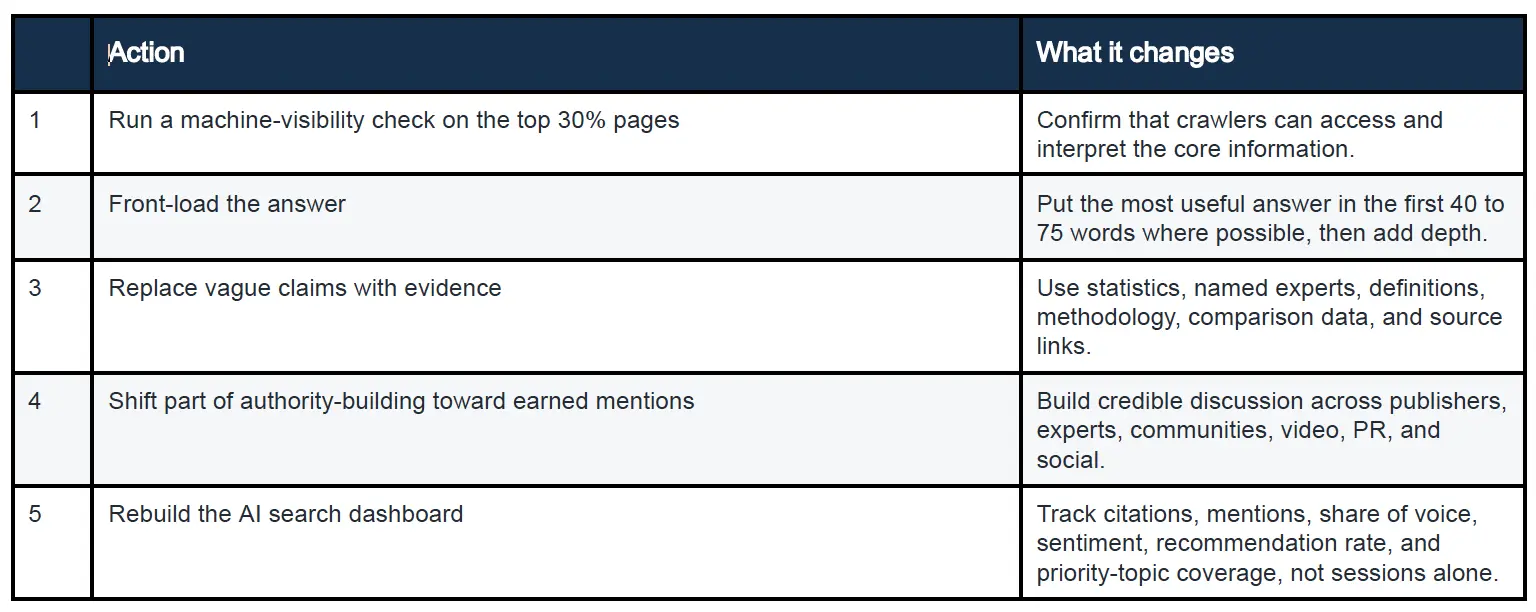
The operating model needs to change with the discovery model
The most important mistake is to create a new GEO team and leave every other marketing function untouched. AI search is forcing the opposite behavior. It makes content architecture a product marketing issue, PR an organic growth issue, video a retrieval issue, social an authority issue, and measurement a brand influence issue.
The organizations that win will not be the ones that chase every weekly change in an LLM. They will be the ones that hold onto the fundamentals: be visible, be citable, be retrievable, answer real customer questions, create credible evidence, distribute expertise across the surfaces buyers use, and measure whether the brand is influencing the decision before the click.
The goal is no longer simply to rank when someone searches. The goal is to be remembered, cited, compared, and recommended while the machine is helping the customer decide.
Receive an AEO Report from Pepper
JOIN OUR AI SEARCH SERIES
